Calculating CGPA sounds simple on the surface, but many students make mistakes that lead to inaccurate results. These mistakes can affect your CGPA itself, your percentage conversion, eligibility for jobs, higher education, scholarships and competitive exam forms. Understanding and avoiding these errors helps you present your academic performance correctly and prevents stress later when it matters most.
In this article, we will walk you through the most common CGPA calculation mistakes Indian university students make, how they happen, and how you can avoid them with clear examples and practical tips.
1. Confusing Credit Hours With Grade Points
One of the most common mistakes students make is mixing up credit hours and grade points.
Credit hours represent how much weight a subject carries in your curriculum, while grade points represent your performance level in that subject. These two are not interchangeable.
For example, if you take a subject worth 3 credits and earn a grade point of 8.5, you should calculate “quality points” as:
3 (credits) × 8.5 (grade point) = 25.5 points
Simply averaging grade points without accounting for the credit value will give you the wrong final CGPA. This mistake often happens when students manually calculate CGPA and overlook subject credits.
2. Using the Wrong Grading Scale
Universities use different grading scales. Some follow a 10-point system, others use different scales or even percentage-to-CGPA maps.
If you mistakenly apply a conversion or grading scale from another university or board, your CGPA will not match the official result.
For example:
A 10.0 system uses direct grade points (like 9.0 or 8.5)
A 4.0 system uses lower numeric values (like 3.5 or 3.0)
Using a 4.0 scale for a 10.0 system compresses scores incorrectly, making your CGPA too low or too high compared to official results. Always verify the grading scale your university uses before calculating.
3. Ignoring Failed or Withdrawn Courses
Some students think that failed courses or withdrawals do not count toward CGPA. This is wrong in most university systems.
If you receive a “Fail” grade, its grade point is 0, and it must be included in your CGPA calculation. If you ignore it, your CGPA will appear artificially high.
Here’s a simple example:
Subject | Credits | Grade Point |
|---|---|---|
Subject A | 3 | A (7.0) |
Subject B | 3 | B (6.0) |
Subject C | 3 | F (0.0) |
If you ignore the failed course:
(7 + 6) ÷ 6 = 2.17
But including the failed course:
(7 + 6 + 0) ÷ 9 = 1.44
This difference matters, especially for job eligibility or admission forms.
4. Confusing SGPA With CGPA
Another common mistake is mixing SGPA (Semester Grade Point Average) with CGPA.
SGPA refers to performance in only one semester.
CGPA reflects performance across all semesters.
Some students average SGPAs without weighting them by credits, which produces incorrect CGPA.
To avoid this, convert each semester’s SGPA into total quality points and then divide by total credits across semesters.
5. Rounding Numbers Too Early
Rounding off intermediate calculation steps is a frequent error. This may look small, but these rounding errors can accumulate and noticeably change your final CGPA.
Always carry full precision during calculations and round only the final CGPA result, typically to two decimal places. Rounding prematurely distorts the data and leads to an inaccurate final average.
6. Including Non-Credit or Audit Courses
Universities may list non-credit courses such as pass/fail classes, seminars, or workshops on transcripts. Some students accidentally include these when calculating CGPA.
Non-credit courses do not affect CGPA and should be excluded from the calculation. Including them distorts the average and misrepresents academic performance.
7. Forgetting to Update After Course Retakes
If you fail a course and retake it, your university has a policy on how that retake affects CGPA. Some institutions replace the old grade with the new one, while others include both attempts in the calculation.
Failing to follow the official retake policy will produce incorrect CGPA. Always check the university’s official guidelines or academic handbook on course repeats and grade replacements.
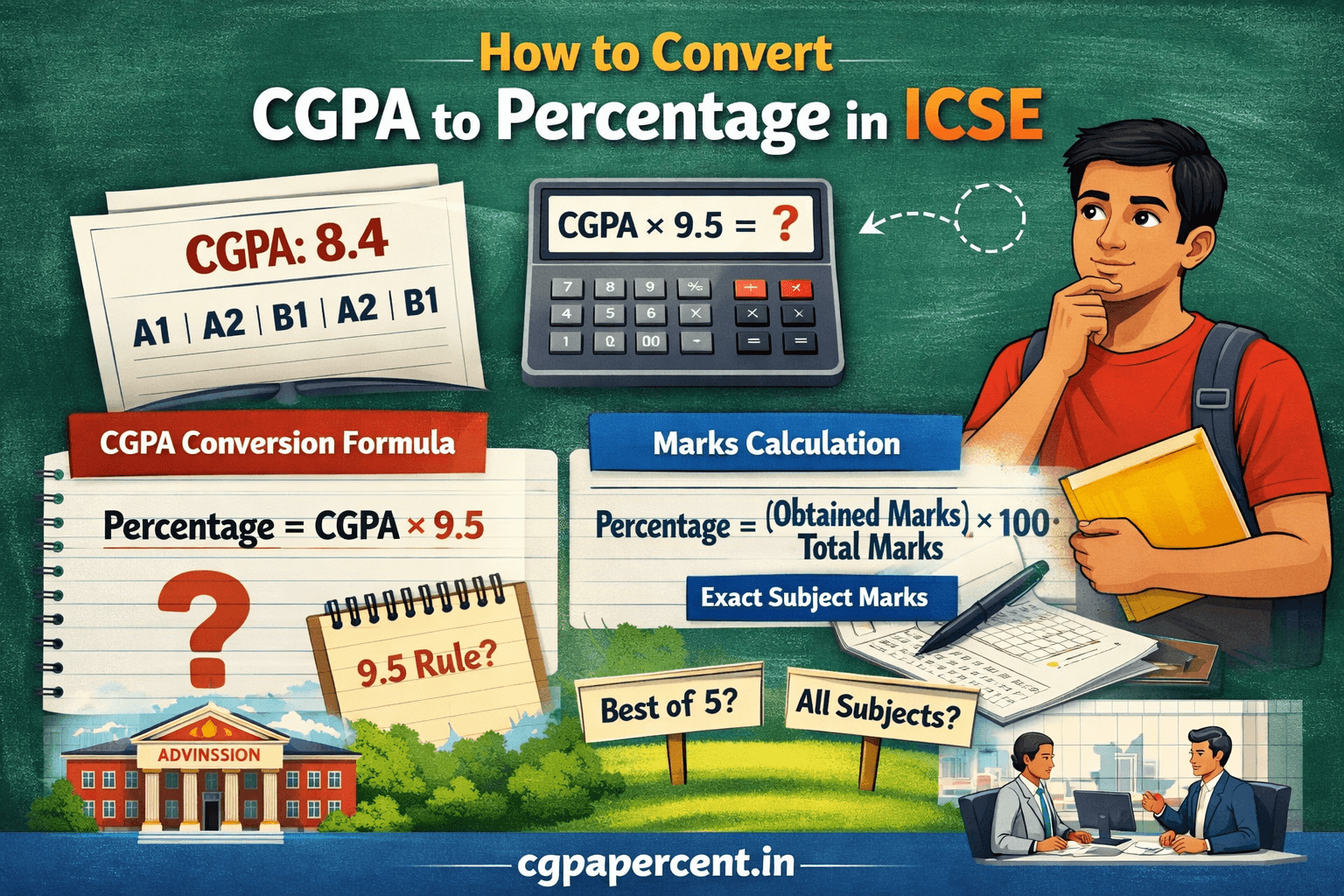
8. Wrong Formula in CGPA to Percentage Conversion
Another major mistake, especially for students filling forms or job applications, is applying the wrong conversion formula for percentage.
Not all universities use the same conversion formula. For example:
Many universities use CGPA × 10
Others use variations like (CGPA − 0.75) × 10 or CGPA × 9.5
Some older schemes require university-specific conversion rules
Using a wrong or generic formula will give you incorrect percentage scores that may cause applications to be rejected.
9. Misinterpreting University Circulars
Sometimes circulars or academic rules are updated, and students continue using old conversion methods. Always check the latest university notifications or regulations. For instance, APJ Abdul Kalam Technological University (KTU) officially uses Percentage = CGPA × 10 for conversion, and this was formally updated in recent academic council decisions.
10. Not Verifying With Official Transcripts
Many students trust online calculators or memory and do not cross-verify with official transcripts. Always check your official result or mark sheet issued by the university registrar before submitting any CGPA or percentage information for jobs, exams or admissions.
Tips to Prevent CGPA Calculation Errors
Here are practical tips you can follow:
✔ Use your university’s official grading table
✔ Enter credits and grade points carefully
✔ Avoid rounding during calculations
✔ Verify with transcripts after each semester
✔ Consult your academic advisor if confused
These steps prevent common mistakes that can hurt your academic record.
Frequently Asked Questions
Q: Can CGPA ever be higher than actual performance?
No. If calculated correctly with credit and grade policies, CGPA accurately reflects your performance.
Q: Should pass/fail courses count?
Non-credit pass/fail courses usually do not count. Always check your university rules.
Q: Does rounding affect job applications?
Yes. Incorrect rounding can change your percentage and affect eligibility thresholds.
Q: Which calculator should I use?
Always use a calculator that matches your university’s grading and credit system.