If you're studying in an Indian university, you've probably heard your professors mention CGPA more times than you can count. But do you actually know how to calculate it from your marks? Most students don't and that's completely normal. The grading system can feel confusing at first, especially when different universities use slightly different methods.
Let me break it down for you in the simplest way possible.
Understanding the Building Blocks
Before we jump into calculations, you need to understand three key terms:
Grade Points: Every marks range gets converted to a grade point. For example, if you score 85-100 marks, you typically get 10 grade points (varies by university). Scoring 75-84 might give you 9 grade points, and so on.
Credits: Each subject carries a certain number of credits based on its importance and contact hours. A major subject like Engineering Mathematics might have 4 credits, while a lab course might have just 2 credits.
SGPA: Semester Grade Point Average, this is your CGPA for just one semester. You'll need SGPA of all semesters to calculate your final CGPA.
The Basic CGPA Calculation Formula
Here's the formula that works for most Indian universities:
CGPA = Sum of (Grade Points × Credits) ÷ Total Credits
This formula applies across all semesters you've completed.
Let me show you with a real example.
Step-by-Step Calculation Example
Imagine you're a Computer Science student in your first semester with these subjects:
Subject | Credits | Marks Obtained | Grade Points |
|---|---|---|---|
Mathematics | 4 | 87 | 9 |
Physics | 3 | 92 | 10 |
Programming | 3 | 78 | 8 |
Engineering Drawing | 2 | 85 | 9 |
English | 2 | 80 | 8 |
Step 1: Multiply grade points by credits for each subject
Mathematics: 9 × 4 = 36
Physics: 10 × 3 = 30
Programming: 8 × 3 = 24
Engineering Drawing: 9 × 2 = 18
English: 8 × 2 = 16
Step 2: Add all these values
36 + 30 + 24 + 18 + 16 = 124
Step 3: Count total credits
4 + 3 + 3 + 2 + 2 = 14 credits
Step 4: Divide to get SGPA (Semester GPA)
124 ÷ 14 = 8.86 SGPA
This 8.86 is your first semester SGPA. To calculate your cumulative CGPA after multiple semesters, you'll repeat this process including all subjects from all completed semesters.
Calculating CGPA Across Multiple Semesters
Let's say you've completed three semesters with these SGPAs:
Semester 1: 8.5
Semester 2: 7.8
Semester 3: 8.2
Many students think you just average these (8.5 + 7.8 + 8.2 ÷ 3 = 8.17). This is wrong if your semesters have different total credits.
The correct method is to go back to the original formula using all subjects from all three semesters. However, if each semester has the same total credits, then yes, you can simply average the SGPAs.
Converting CGPA to Percentage
Most job applications and further education forms ask for percentage, not CGPA. Here's where it gets tricky—different universities use different conversion formulas.
Most common formula (UGC recommended):
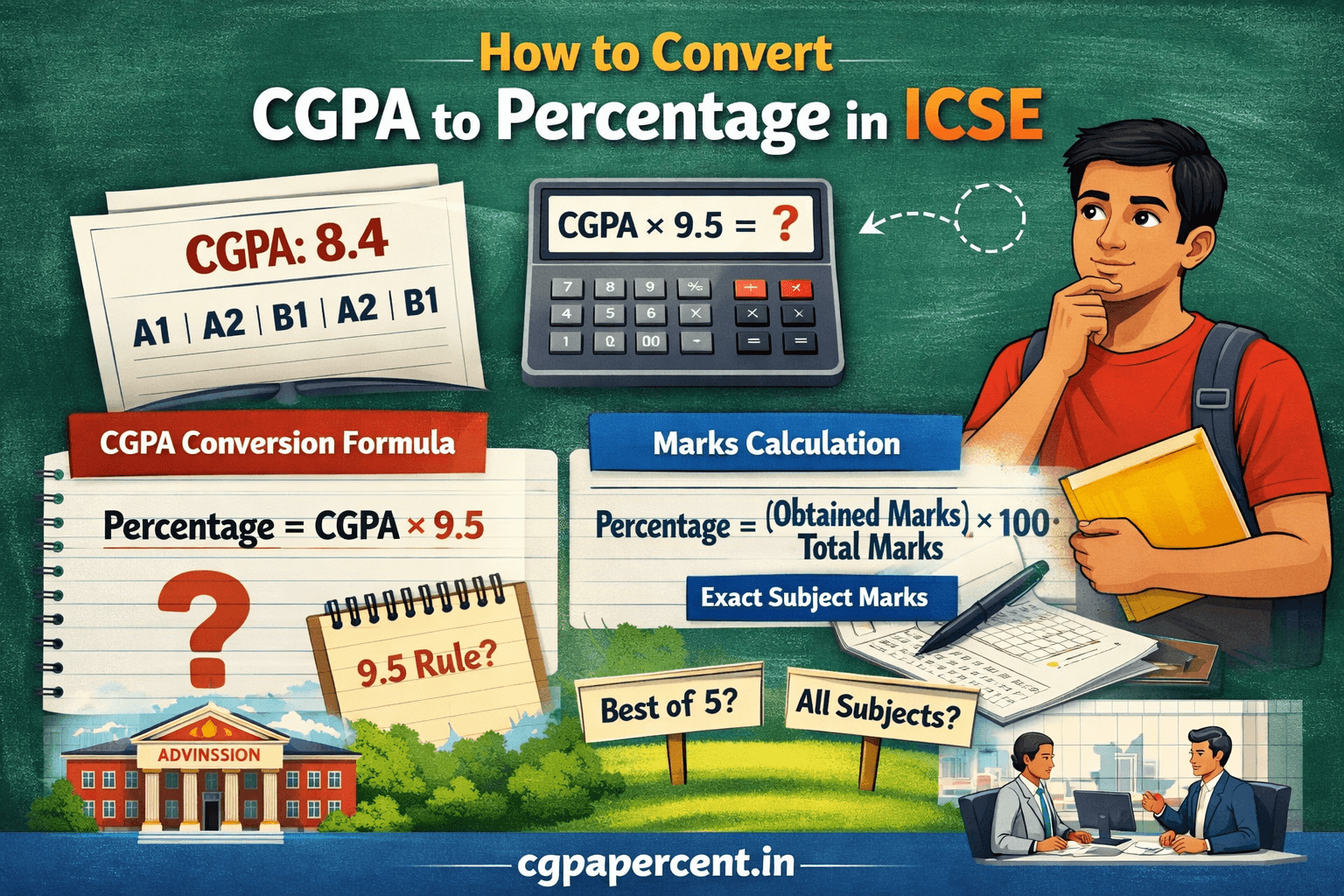
Percentage = CGPA × 9.5
So if your CGPA is 8.2:
8.2 × 9.5 = 77.9%
But wait—some universities differ:
IITs and NITs: Percentage = (CGPA - 0.75) × 10
VTU: Percentage = (CGPA - 0.75) × 10
GTU: Percentage = (CGPA - 0.5) × 10
Anna University: CGPA × 10
Delhi University: CGPA × 9.5
Always check your university's official conversion formula on your marksheet or university website.
Common Mistakes Students Make
Mistake 1: Ignoring credits
Some students just average all grade points without considering credits. A 3-credit subject should weigh less than a 4-credit subject in your calculation.
Mistake 2: Forgetting failed subjects
If you failed a course and got F (0 grade points), you still need to include it in your CGPA calculation with its credits. Many students skip it, which gives them an inflated CGPA.
Mistake 3: Mixing up SGPA and CGPA
SGPA is for one semester only. CGPA is cumulative, it includes all semesters from the beginning of your course.
What's a Good CGPA?
In Indian universities:
9.0-10.0: Outstanding, you're among the top students
8.0-8.9: Excellent, very competitive for placements and higher studies
7.0-7.9: Good, decent performance, most companies will shortlist you
6.0-6.9: Average, you're passing comfortably but need improvement
5.0-5.9: Below average, focus on improving
Below 5.0: At risk, many universities require minimum 5.0 CGPA to graduate
Remember, CGPA requirements vary for different opportunities. Most IITs require minimum 6.5-7.0 for placements in top companies, while government jobs might have different criteria.
Quick Tips for Managing Your CGPA
Focus on high-credit subjects: If Mathematics carries 4 credits and English carries 2, scoring well in Mathematics impacts your CGPA more.
Don't write off any semester: Since CGPA is cumulative, a bad semester drags down your overall score for years. Consistent performance matters more than one stellar semester.
Check your grade points regularly: Get your semester marksheet and verify the grade points assigned. Universities sometimes make errors.
Understand your university's grading scale: Some universities are more lenient (85 marks = 10 GP) while others are stricter (90 marks = 10 GP). Know where you stand.
Final Thoughts
Calculating CGPA isn't rocket science, but it does require attention to detail. The basic formula remains the same across Indian universities multiply grade points by credits, sum them up, and divide by total credits. The confusion usually comes from different grading scales and percentage conversion formulas.
Keep track of your SGPA each semester, understand how credits work, and you'll never be surprised by your final CGPA. And if math isn't your thing, plenty of online CGPA calculators can do the heavy lifting just make sure you're using one designed for your specific university's grading system.
Your CGPA is important, but it's not everything. It opens doors for placements and higher education, but your skills, projects, and internships matter just as much. Use CGPA as a metric to track your academic progress, not as the sole definition of your worth as a student.