How to Convert CGPA to Percentage in ICSE
When students see their ICSE or ISC result in CGPA or grade form, one of the first questions that comes up at home is simple: “Percentage kitni bani?” That question sounds small, but in India it matters a lot. It comes up during admissions, scholarship forms, relatives’ calls, college applications, and sometimes even during job form filling later on.
The confusion starts because many students know their grades are good, but they do not know how to express them in percentage terms properly. Some use random online formulas. Some multiply by the wrong number. Some assume every board uses the same conversion rule. That is where mistakes happen.
If you are trying to convert CGPA to percentage in ICSE, the process is not complicated, but it should be understood carefully. More importantly, you should also know where this converted percentage is useful and where the original marksheet matters more.
What does CGPA mean in the ICSE context?
CGPA stands for Cumulative Grade Point Average. It is meant to show overall academic performance in a compact form. Instead of only looking at raw marks subject by subject, CGPA gives a summarized academic indicator.
For many students, CGPA feels easier to understand when results are first declared. But the moment they need to fill a college form, compare eligibility, or explain scores to someone, percentage becomes the more commonly asked format.
That is why students search for conversion methods immediately after results.
The basic ICSE CGPA to percentage formula
A commonly used way to convert CGPA to percentage is:
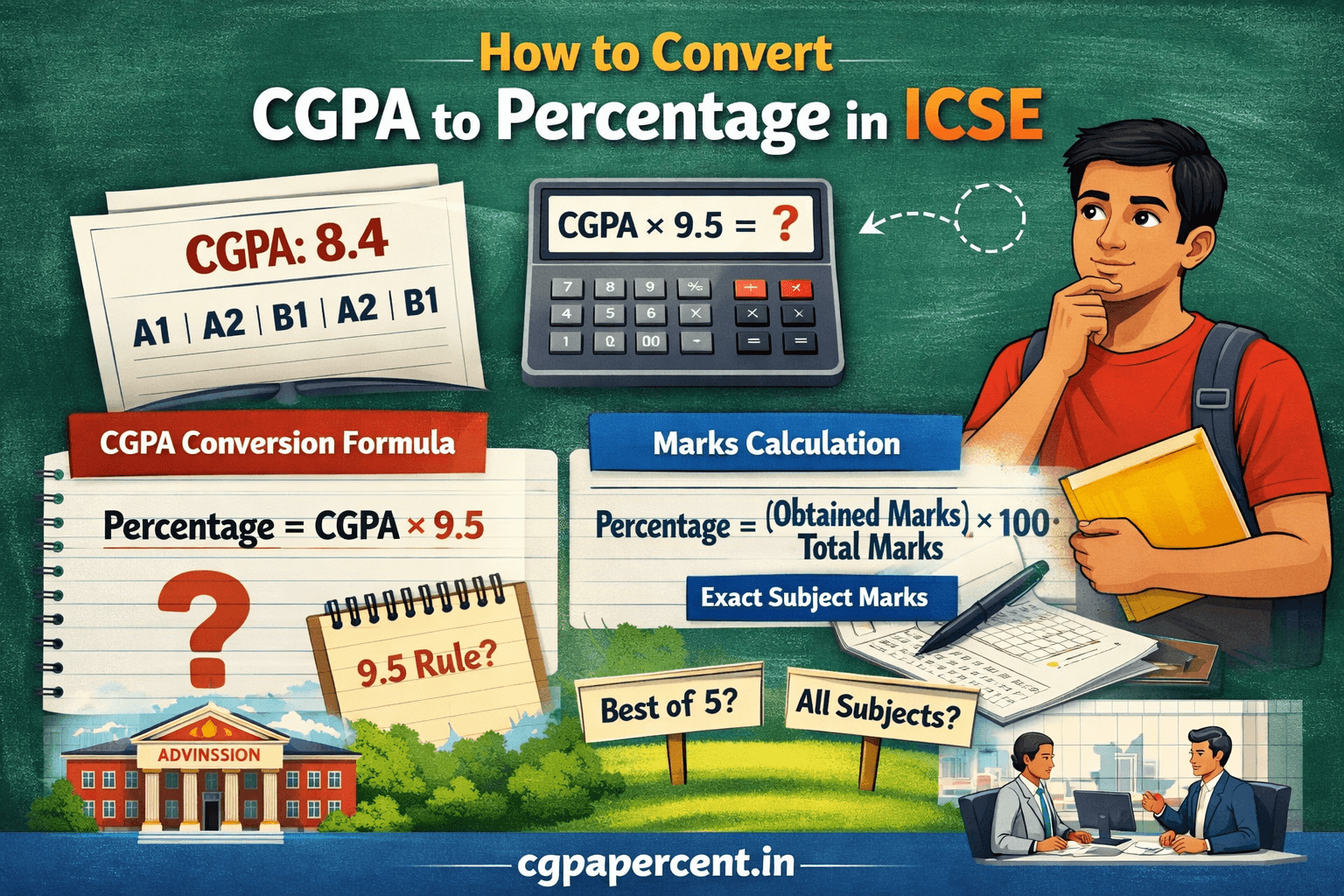
Percentage = CGPA × 9.5
So if your CGPA is 8.0, then:
8.0 × 9.5 = 76%
If your CGPA is 9.2, then:
9.2 × 9.5 = 87.4%
This is the kind of conversion students are usually looking for when they want a quick percentage estimate from CGPA.
Why students get confused during conversion
The main problem is that students assume one conversion rule works everywhere. In India, that is rarely true. One board may use one method, another university may use a different multiplier, and some colleges may even mention their own calculation basis.
This is why two students can both say they have “around 80%,” but one reached that figure through official marks and another through conversion logic.
In practical life, that difference matters.
For ICSE-related result interpretation, students should be careful not to blindly copy formulas used by CBSE, universities, engineering colleges, or private institutions. Many students mix all of these together and end up quoting a percentage that does not match what an admission office expects.
A realistic student situation
This happens a lot after result day.
A student gets a good CGPA and feels relieved. Then a college form asks for percentage. The family starts searching online. One website says multiply by 9.5. Another says use best of five. Someone in the house says English should be compulsory in the calculation. A friend says only main subjects count.
At that point, panic starts for no reason.
This is exactly why students should separate three different things:
Estimated percentage from CGPA
Percentage based on actual subject marks
Percentage calculation method required by a college or university
These are not always the same.
Is CGPA conversion always the best way to calculate percentage?
Not necessarily.
If your marksheet already shows subject-wise marks, then in many real admission situations, calculating percentage directly from marks is more reliable than converting CGPA. That is because colleges often want marks-based percentages, not an approximate converted value.
For example, if a college asks for percentage based on best five subjects, then the correct answer may come from your marks, not your CGPA.
If a college asks for all subjects included, again, the subject marks matter.
So CGPA conversion is useful, but it should not replace reading the exact admission instruction.
How students usually calculate percentage from marks instead
A lot of ICSE students eventually realize that direct marks calculation is simpler for forms.
The usual approach is:
Percentage = (Total marks obtained / Total maximum marks) × 100
Suppose you scored 410 out of 500 in best five subjects:
(410 / 500) × 100 = 82%
This is often more concrete than saying your CGPA converts to some percentage.
That is why many students who are applying for college admissions rely more on the marksheet total than on a CGPA conversion estimate.
Where CGPA to percentage conversion actually helps
Even though direct marks are often stronger, CGPA conversion is still useful in many situations.
It helps when:
You want a quick understanding of your overall score
Many students just want to know whether their result is roughly in the 70s, 80s, or 90s range.
You are comparing your result informally
During counselling, discussions with seniors, or early planning, a converted percentage helps you judge where you stand.
A form asks for percentage but you are starting from CGPA
Some forms are not detailed. They simply ask for an academic percentage. In such cases, students sometimes use the converted figure, unless the instructions specify otherwise.
You want to compare your school result with later college performance
A lot of students mentally compare school academics with college CGPA and percentage trends.
Common mistakes students make
There are some repeated mistakes that happen every year.
Using random online formulas
Students copy the first formula they see without checking whether it applies to their system.
Assuming every institution accepts converted percentage
Some colleges accept it. Some want exact marks. Some follow best-of-five. Some have subject-specific eligibility.
Ignoring subject rules
A course may require a certain percentage in Maths, English, or Science specifically. Overall converted percentage alone may not be enough.
Rounding too aggressively
A student with 8.26 CGPA may round it too early and present an inaccurate percentage. Small differences can matter in cutoffs.
Treating estimate as official
This is a very common problem. Converted percentage is often used as a convenience, but official evaluation is usually based on marksheets and institutional rules.
How this affects college admissions
This is where things become practical.
In Indian admissions, percentage still carries emotional and administrative weight. Even when systems are becoming broader, application forms still often ask for percentages because they are easier to compare across applicants.
But colleges usually do not want guesswork. They want one of the following:
exact marks
board-declared result details
best-five percentage
subject-specific eligibility
official conversion rule, if applicable
So if you are applying somewhere, the safest approach is this:
check the form instructions
read the eligibility note carefully
use marks-based calculation when asked
use CGPA conversion only where appropriate
Students who skip this step often create avoidable errors in their applications.
Does converted percentage affect your future a lot?
In the short term, yes, it can matter for admissions and form filling.
In the long term, much less.
This is something many students do not fully understand while they are still in school. Right after board results, percentage feels like everything. But after college starts, performance shifts to semester marks, SGPA, CGPA, internships, skills, and project work.
Later in placements, your college record becomes more important than your ICSE conversion method. And after your first serious role, skill, experience, communication, and work quality matter far more than whether your school CGPA converted to 84.5% or 85%.
That does not mean school marks are useless. It just means students should handle them correctly without making them bigger than they really are.
The real academic takeaway
Students should think of CGPA to percentage conversion as an administrative tool, not as a source of stress.
Its purpose is to help you present your result in a familiar format. It is not meant to confuse you, and it definitely should not become another panic point after results.
The smarter approach is simple:
Understand the formula, but do not stop there.
Also understand:
whether your institution wants marks or converted percentage
whether best five subjects are counted
whether specific subjects matter
whether you should use exact marks from the marksheet
That practical clarity saves more trouble than memorizing formulas.
Final thought
A lot of Indian students get stuck not because the calculation is difficult, but because the system around marks is inconsistent. One school says one thing, one college says another, and family members often add more confusion than clarity.
So for ICSE students, the best mindset is this: use CGPA conversion as a helpful estimate, but trust the actual marksheet and official instructions when something important like admission, eligibility, or documentation is involved.
That is the difference between casually knowing your score and using it correctly where it matters.
FAQs
1. What is the formula to convert CGPA to percentage in ICSE?
The commonly used formula is:
Percentage = CGPA × 9.5
So if your CGPA is 9.0, your percentage becomes 85.5%.
2. Can I use CGPA conversion for college admission forms?
You can use it only if the form allows that format. Many colleges prefer actual marks or percentage calculated from marks, so always check the instructions.
3. Is converted percentage the same as marks-based percentage?
Not always. A converted percentage is often an estimate based on CGPA, while marks-based percentage comes directly from your subject scores.
4. Should I calculate percentage from all subjects or best five?
That depends on the college or institution asking for the result. Some consider best five, while others may ask for all required subjects.
5. Which is more reliable: CGPA conversion or marksheet calculation?
For official purposes, marksheet-based calculation is usually more reliable unless a specific conversion rule is clearly accepted.
6. Can wrong percentage conversion create admission problems?
Yes, it can. If you enter a percentage using the wrong method, it may create mismatch issues during document verification.
7. Does ICSE percentage still matter after school?
It matters for admissions and some early filters, but over time your college performance, skills, and experience become more important.
8. What should I do if a college form is unclear about calculation method?
Read the official eligibility page carefully. If it still seems unclear, use the institution’s stated rule or contact the admissions office before submitting the form.