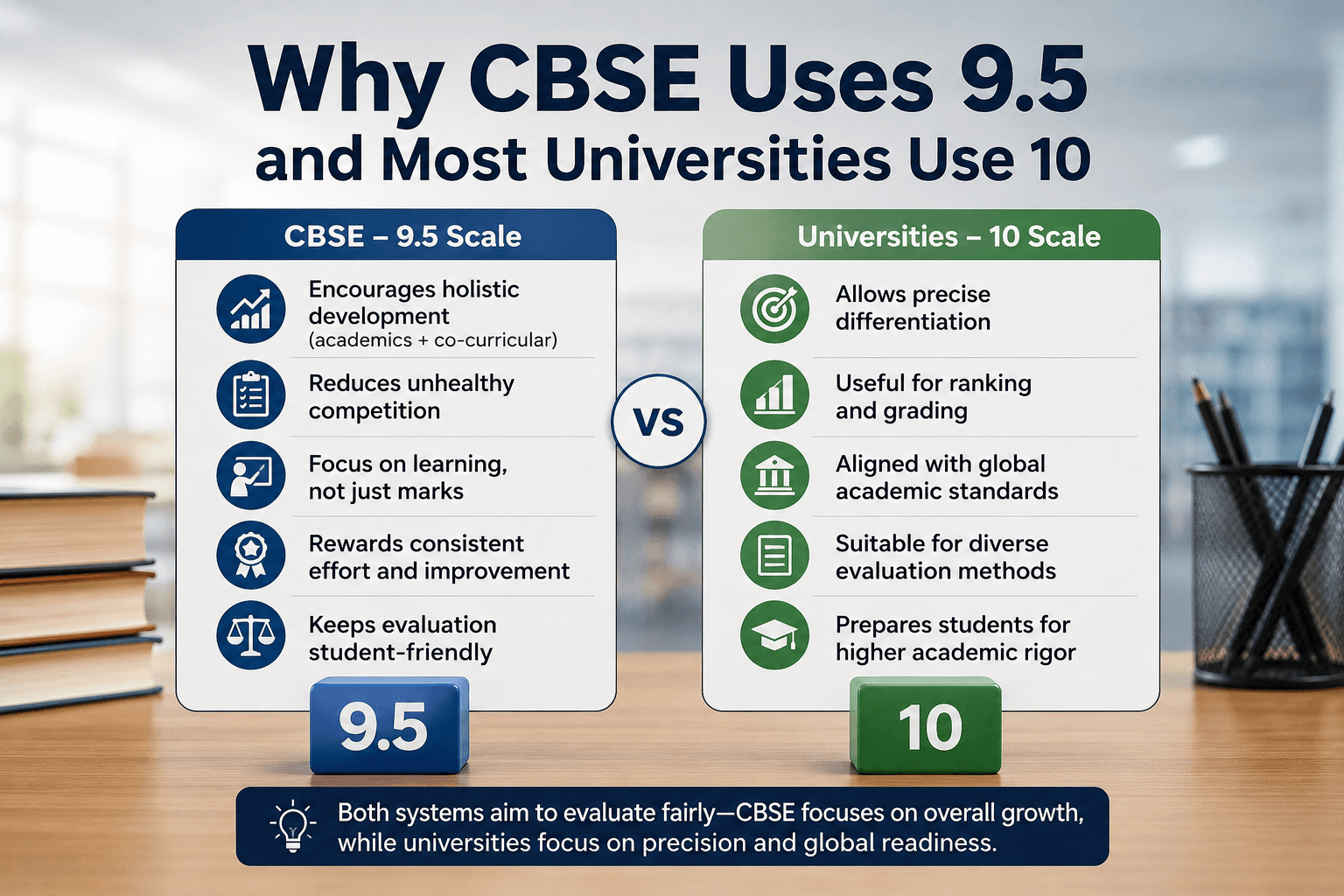
Results come out, and suddenly everyone becomes a math expert. One friend says CBSE uses 9.5, another says university CGPA is on 10, and you are left staring at your marksheet wondering what it all really means. The honest answer: CBSE uses 9.5 because its grading system is built to map marks to grade points in a way that fits board reporting, while most universities use 10 because that is the standard CGPA scale for semester-based college evaluation.
The confusion is real. And it gets worse because people mix up percentage, CGPA, and the conversion formula like they are the same thing. They are not.
What you are really asking here
If you clicked this title, you are probably asking more than one thing at once. You want to know why school marks and college marks use different scales, whether a 9.5 or 10 matters for admissions, how to convert your score correctly, and whether recruiters even care. You may also be trying to figure out if your CGPA is “good enough” for placements, internships, or higher studies.
- Why does CBSE use 9.5 while colleges say 10-point CGPA?
- How do I convert CGPA to percentage the right way?
- Does a 9.5 board score mean the same thing as a 9.5 university CGPA?
- Will recruiters shortlist based on this number?
- What matters more: CGPA, backlogs, or interview performance?
Why CBSE chose 9.5 in the first place
CBSE did not pick 9.5 randomly. In the old board system, marks were often converted into grade points through a table where the top grades had to stay distinct without making every high scorer look identical. That is where the 9.5 multiplier came in for percentage conversion in many CBSE contexts: a student with a CGPA of 9.0 was converted to 85.5%, not 90%, because the board’s grade-point table was never meant to work like a direct 1-to-10 percentage ladder.
That is why you see the formula CGPA × 9.5 for CBSE board results. A 10 CGPA becomes 95%, not 100%. A 9 CGPA becomes 85.5%. It looks strange if you expect perfect linearity, but it was designed to match how board grades were spread across performance bands.
Do not use the CBSE board formula on university CGPA. That is one of the most common mistakes students make while filling forms.
Why most universities stick to a 10-point scale
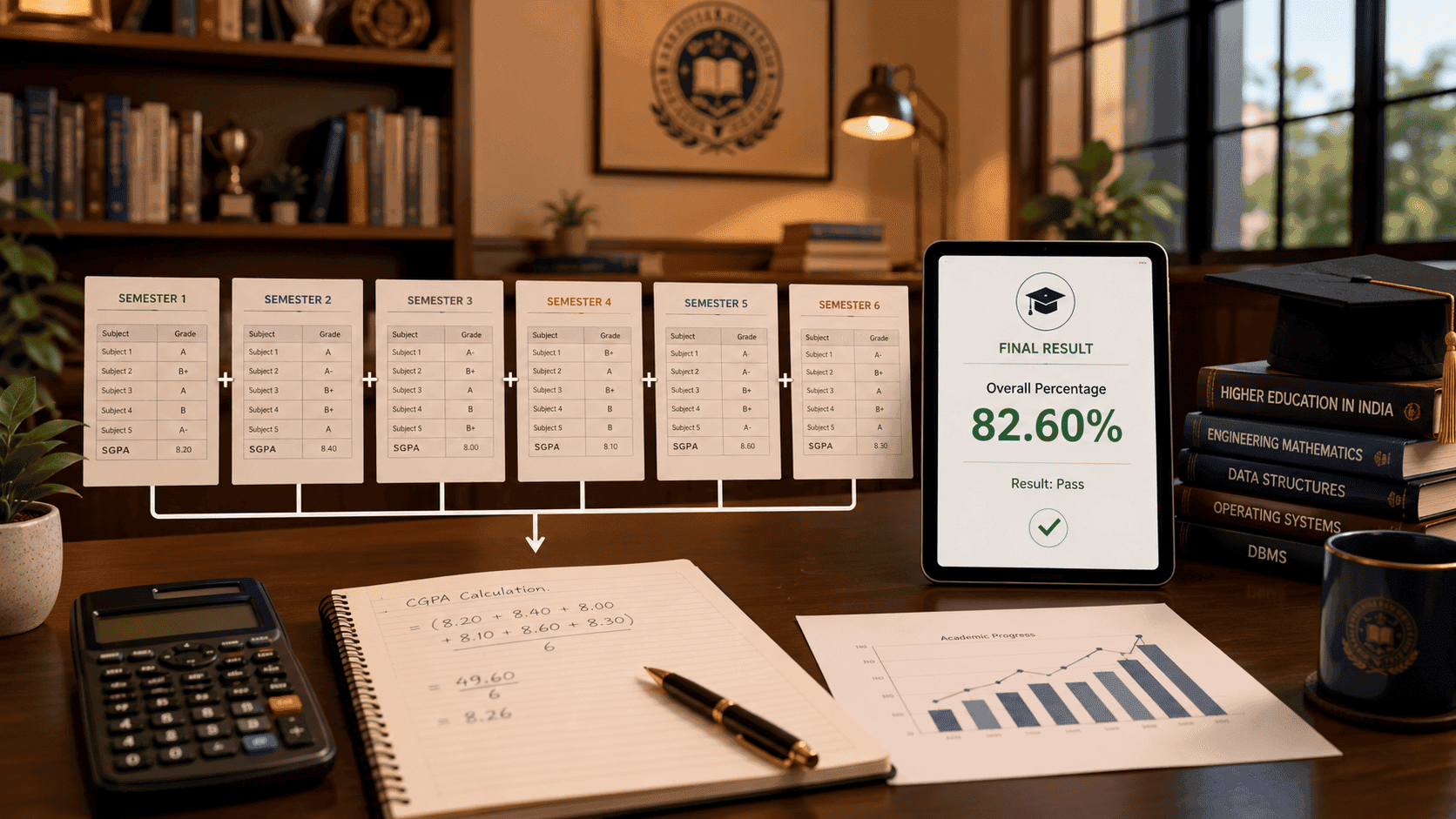
College and university grading in India is built differently. A semester system needs a clean, standard scale to calculate SGPA and CGPA across subjects, labs, credits, and multiple semesters. A 10-point scale makes that simpler, especially when one paper has 4 credits and another has 2. The university is not trying to convert your marks into a board-style percentage story. It is tracking performance across semesters.
That is why most engineering and degree colleges use CGPA on a 10-point scale. A 9.2 in college is not the same thing as a school 9.2. It means your weighted average across semesters sits at 9.2 out of 10, based on the marks-to-grade mapping used by that university. If you want a quick estimate, many students multiply by 10 for a rough percentage equivalent. So 9.2 CGPA is about 92% in that rough sense, unless your university specifies a different conversion rule.
If you are checking your own score, use a proper tool like the CGPA conversion chart or the CGPA calculator instead of copying random formulas from WhatsApp.
The difference between eligibility and final selection
This is where students get trapped. A college can put 6.0 or 7.0 CGPA as the eligibility cut-off for sitting in a placement drive, but that does not mean 7.0 guarantees selection. It only means you are allowed into the first round. After that, aptitude test, coding rounds, group discussion, and interview matter more than the exact decimal.
Here is how it plays out on campus. A CSE student with 8.8 CGPA may miss a top-off-campus shortlist because of one backlog in the past, while another student with 7.4 and no backlogs gets shortlisted because the company’s filter is only “7 CGPA and above, no active backlog.” That is the real game. Eligibility gets you in. Performance gets you the job.
What a 9.5 means in school and what a 10 means in college
Do not confuse the numbers just because they look similar. In CBSE, a 9.5 is tied to board-grade conversion. In university, 10 is the highest point on a semester grading scale. The number looks close, but the systems are different underneath. One is a board conversion, the other is an academic average over credits and semesters.
| System | Scale | What it means | Common conversion |
|---|---|---|---|
| CBSE board | 10-point grade system | Grade points converted to percentage | CGPA × 9.5 |
| Most universities | 10-point CGPA | Semester performance across credits | CGPA × 10 for rough percentage equivalence |
So yes, a 9.5 in CBSE and a 9.5 in university are not twins. One is a board result conversion. The other is a college academic record. Same-looking number. Different meaning.
Where recruiters actually care, and where they do not
For campus placements, recruiters care at the gate and then again at the interview. At the gate, your CGPA and backlog status may decide whether you are even allowed to sit. Once you clear that, your resume, aptitude, technical basics, and communication take over. A student with 9.3 CGPA and weak problem-solving can still lose to someone with 7.2 who prepared properly.
For off-campus hiring, the number still matters, but not as a guarantee. Many companies use filters like 60%, 65%, or 7 CGPA. Some ask for “no active backlog.” Some do not care after the first resume screen. The uncomfortable truth is this: above a decent threshold, your CGPA stops being a badge and becomes only a filter. It does not carry you through interviews. It only keeps the door open.
If you are a degree college student applying after graduation, your final semester marks and backlog status can matter as much as overall CGPA. A clean record with a 7.4 often looks more practical than a 9.1 with repeated backlogs or delayed credits.
How to convert the number without fooling yourself
Use the right formula for the right system. CBSE board percentage from CGPA is commonly calculated as CGPA × 9.5. University CGPA to percentage, in many Indian colleges, is treated as CGPA × 10 unless the university gives its own rule. That is the first thing you should check before filling any form.
- Look at your marksheet and identify whether it is CBSE board CGPA or university CGPA.
- Check if your college has an official conversion method on the website or transcript.
- Use the correct formula. For example, 8.4 × 10 = 84% in a common university interpretation.
- If the application asks for marks in a specific format, enter exactly that, not your estimate.
- Keep a screenshot or PDF of the official rule in case the admissions office asks later.
Do not round aggressively. 8.46 is not 8.5 when the form or recruiter wants two decimal places. Small differences can matter in cut-off-based applications.
The part nobody tells you about “good CGPA” in India
A high CGPA helps most when it is protecting you from a filter. That is all. After that, the advantage drops fast. A 9.8 student with no projects, no internships, and no interview practice can get stuck, while a 7.5 student with one solid internship and decent coding or core subject clarity can move ahead.
There is also a silent rule in many colleges: once you cross the eligibility bar, the extra points stop buying much. Going from 6.8 to 7.6 can change your placement access. Going from 8.6 to 9.4 may not change anything at all for most recruiters. That is why students obsess too much over decimals and too little over skills, project depth, and backlogs.
If you are still early in college, aim for a clean, stable record. No active backlogs. No repeated revaluation drama. A CGPA that keeps you eligible. That is enough for a lot of decent companies.
What you should do right now
If you are filling a form tonight, do this in order. First, check whether the form wants board percentage, university CGPA, or semester-wise marks. Then use the official conversion rule from your board or university. If you still are not sure, search your college circular or ask your placement cell before submitting anything. Wrong entry can create avoidable trouble later.
And if this is about placements, stop staring at the number for one minute and check the things that actually block students: active backlogs, missing credits, low attendance, and weak interview preparation. The CBSE uses 9.5 and most universities use 10 question matters, yes. But the bigger question is whether your record is clean enough to sit, and your preparation strong enough to get through.
Frequently Asked Questions
Why does CBSE convert CGPA to percentage using 9.5?
Because CBSE’s old grade-point mapping was designed around grade bands, not a direct 1-to-1 marks scale. The board used CGPA × 9.5 as a standard conversion for board results. So a 9.0 becomes 85.5%, and a 10.0 becomes 95%. It is a board rule, not a university rule.
Can I use university CGPA × 9.5 too?
No, not unless your university says so in writing. Most universities that use a 10-point CGPA expect a rough percentage equivalent of CGPA × 10, or they provide a separate formula. Use the university’s official conversion rule on transcripts, ordinances, or the exam branch website.
Will a 7 CGPA stop me from getting placements?
No. It may stop you from some company filters, but it does not stop you from placements as a whole. Many companies use cut-offs like 6.0, 6.5, or 7.0. After that, your performance in aptitude, technical rounds, and interview matters more than the exact CGPA.
Is a 9.5 CGPA in college the same as 95%?
In many universities, people use that rough conversion, yes: 9.5 × 10 = 95%. But always check your university’s official policy. Some institutions use different equivalence rules for transcripts, overseas applications, or grade conversion letters.
Do backlogs matter more than CGPA?
For many recruiters, yes. A clean record with one moderate CGPA can beat a higher CGPA with active or repeated backlogs. A backlog tells a company something about consistency and eligibility. CGPA alone does not fix that.
What if my marksheet shows SGPA, not CGPA?
SGPA is semester GPA. CGPA is the cumulative average across semesters. For applications and placements, colleges usually ask for CGPA because it shows your overall record. If you only have SGPA, calculate the cumulative figure from your official marksheet or transcript.
If you are checking your own score today, do not guess. Pull out the marksheet, use the official formula, and verify it against your university or board rule. If you want, start with your CGPA now and see what it converts to using the conversion chart before you submit the next form with the CBSE uses 9.5 and most universities use 10 confusion cleared once and for all.