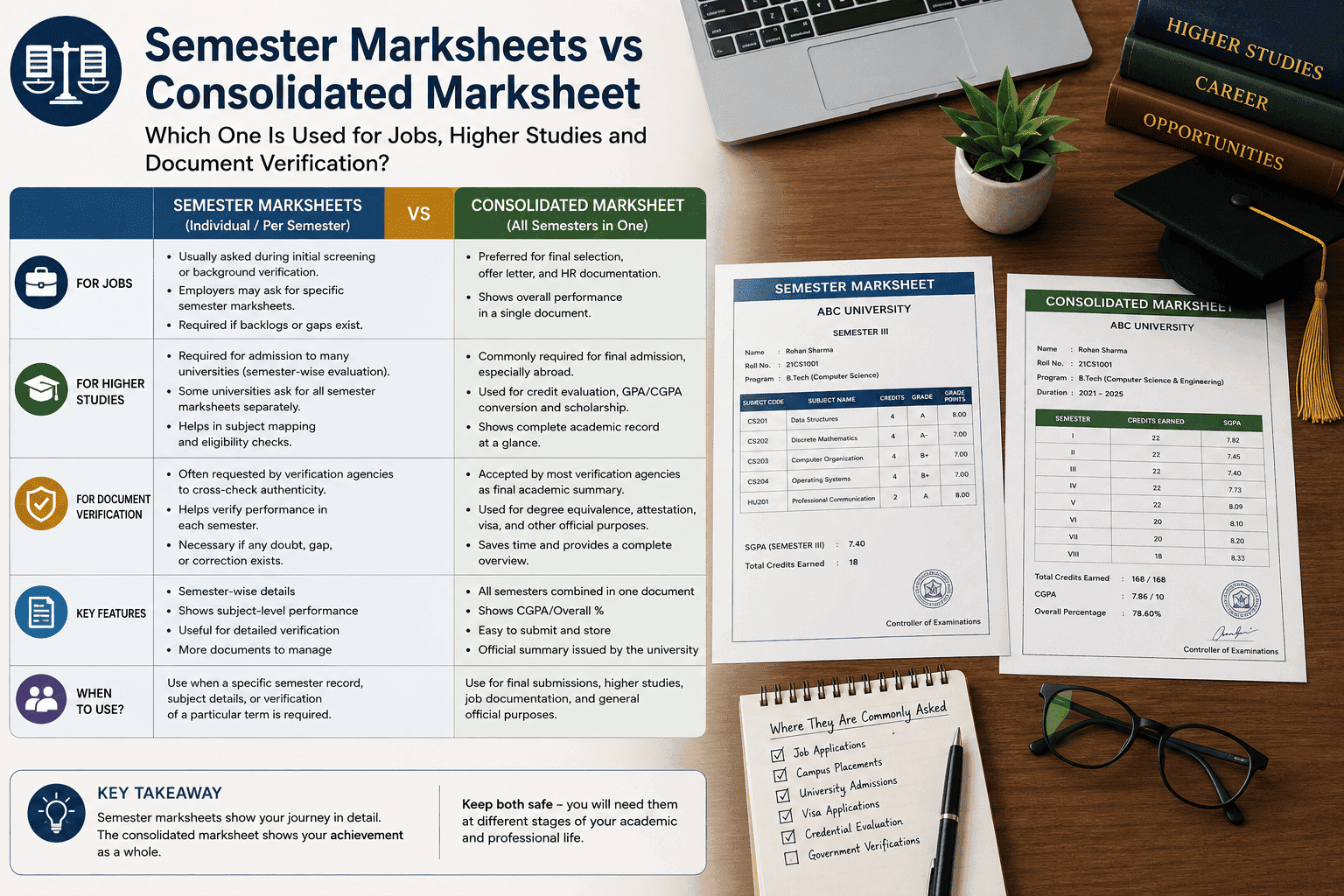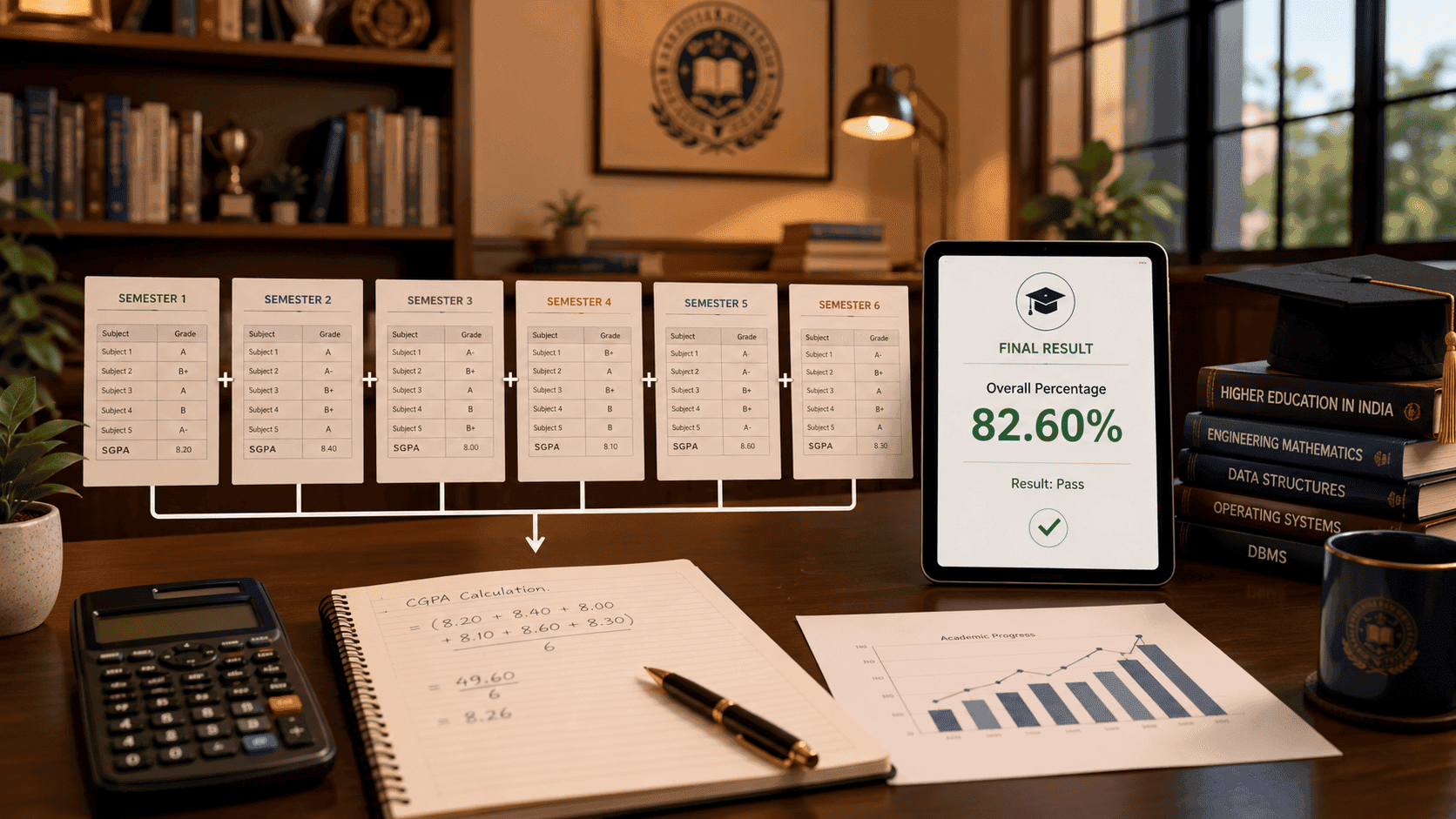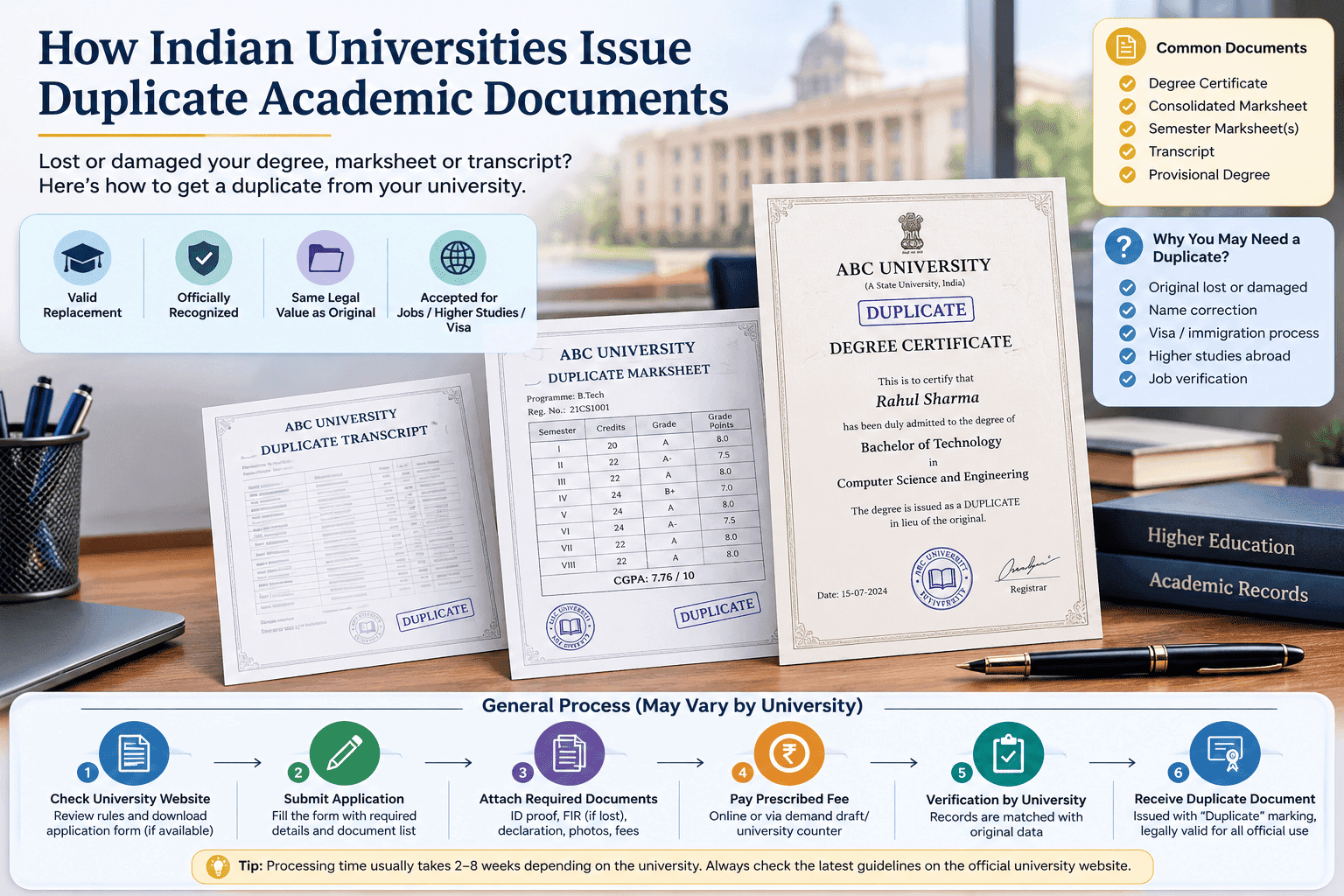
A university grade card is easiest to read from left to right: identify the course, check its assigned credits, read the letter grade and grade point, multiply the credits by the grade point to understand the credit points, then use the semester totals to verify the SGPA. Earned credits tell you something different: how many course credits you have actually secured toward the programme.
The terminology is widely used across Indian universities, but the exact grade scale, pass rule, result codes and treatment of failed courses are not identical everywhere. Under the UGC Minimum Standards Regulations, 2025, the appropriate academic body of each university determines course credits and evaluation components, and HEIs are required to adopt their own grade-to-percentage conversion arrangements.
This means the calculation logic on a grade card can be understood systematically, but the legend printed by your university, and the regulation applicable to your programme and batch, still controls what a particular letter or status code means.
The six numbers on a grade card that students most often confuse
Field | What it tells you | What it is not |
|---|---|---|
Course credits | The credit weight assigned to a course. | Not the marks you scored. |
Grade point | The numerical value attached to the grade earned in that course under the university's grading scale. | Not the number of course credits. |
Credit points | Course credits multiplied by the grade point. | Not the same as earned credits. |
Earned credits | Credits successfully secured after satisfying the applicable passing requirements. | Not the weighted score used directly as SGPA. |
SGPA | A credit-weighted measure of performance for one semester. | Not normally a simple average of the letter grades. |
CGPA | A cumulative credit-weighted measure across the applicable semesters. | Not necessarily the arithmetic average of all SGPAs. |
The distinction between credit and credit point is particularly important. The University of Calcutta's 2025 B.A. LL.B. regulations define a credit point as the product of the number of credits assigned to a course and the grade point obtained in it. The same regulations calculate SGPA from the total credit points and total credits of the semester.
So a 4-credit course in which the student receives grade point 9 contributes:
4 credits × 9 grade points = 36 credit points
The student has not "earned 36 credits." The course is still worth 4 credits. The number 36 is its contribution to the weighted grade calculation.
Sample grade card 1: a complete semester with all courses passed
The grade card below is an original illustration, not a copy of any student's result or any particular university's mark sheet. It uses a fictional 10-point grading scale only to demonstrate how the fields connect.
Course Code | Course Title | Course Credits (C) | Letter Grade | Grade Point (G) | Credit Points (C × G) | Earned Credits |
|---|---|---|---|---|---|---|
ECO101 | Principles of Economics | 4 | A | 8 | 32 | 4 |
POL101 | Political Institutions | 4 | A+ | 9 | 36 | 4 |
ENG101 | Academic Writing | 4 | B+ | 7 | 28 | 4 |
VAC101 | Environmental Studies | 3 | A | 8 | 24 | 3 |
SEC101 | Data Skills | 3 | O | 10 | 30 | 3 |
AEC101 | Communication Skills | 2 | A+ | 9 | 18 | 2 |
Semester Total | 20 | 168 | 20 |
SGPA: 8.40
Semester Credits: 20
Earned Credits: 20
Result: PASS
How the SGPA on this grade card is calculated from the rows
There is no separate hidden score needed for this example. Each row already provides the information required.
The course-wise credit points are:
32 + 36 + 28 + 24 + 30 + 18 = 168
The semester contains:
4 + 4 + 4 + 3 + 3 + 2 = 20 credits
The SGPA is therefore:
SGPA = Total Credit Points ÷ Total Semester Credits
SGPA = 168 ÷ 20 = 8.40
This is the basic credit-weighted principle used in systems such as the University of Calcutta's 2025 B.A. LL.B. regulations, which express SGPA as Σ(Ci × Gi) ÷ ΣCi and report the result to two decimal places.
Read each course row in this order
1. Course code and course title
The course code identifies the exact paper or course to which the grade belongs. This matters when two courses have similar names or when a student has taken a major, minor, multidisciplinary, skill or value-added course in the same semester.
When checking a suspected result error, use the course code rather than relying only on the abbreviated course title.
2. Course credits
Course credits represent the academic credit value assigned to the course. A 4-credit course therefore carries twice the weighting of a 2-credit course when the SGPA formula multiplies credit by grade point.
This means two identical grades can affect SGPA differently.
Course | Credits | Grade Point | Credit Points |
|---|---|---|---|
Course A | 4 | 9 | 36 |
Course B | 2 | 9 | 18 |
Both courses have grade point 9, but Course A contributes twice as many credit points because it carries twice as many credits.
3. Letter grade
A letter grade is the university's categorical description of performance in that course. Common labels include O, A+, A, B+, B, C, P and F, but the labels and their corresponding percentages are not nationally interchangeable.
For example, the University of Calcutta's 2025 B.A. LL.B. regulation assigns O and grade point 10 to 90 to 100 marks, followed by A+ at 9 and A at 8.
The University of Kashmir's FYUGP statutes, updated through April 2026, instead use A+ as the grade letter carrying grade point 10 for the 90 to 100 band, followed by A at 9 and B+ at 8.
Percentage band | University of Calcutta B.A. LL.B. 2025 | University of Kashmir FYUGP |
|---|---|---|
90 to 100 | O, Grade Point 10 | A+, Grade Point 10 |
80 to below 90 | A+, Grade Point 9 | A, Grade Point 9 |
70 to below 80 | A, Grade Point 8 | B+, Grade Point 8 |
A grade of A+ therefore cannot be interpreted accurately without knowing which university's grading table applies.
4. Grade point
The grade point is the numerical value used in the SGPA or CGPA calculation. It is not the percentage itself.
If a 4-credit course receives grade point 8:
4 × 8 = 32 credit points
If the same course receives grade point 5:
4 × 5 = 20 credit points
The course still carries 4 academic credits in both cases. What changes is the grade point and therefore its contribution to the semester average.
5. Credit points
Credit points are sometimes the easiest column for checking whether the grade card's SGPA is arithmetically consistent.
Use:
Credit Point = Course Credit × Grade Point
If your mark sheet shows 3 credits, grade point 8 and 24 credit points, the row is internally consistent:
3 × 8 = 24
If it shows 3 credits, grade point 8 and 32 credit points, there is either another rule involved or a value that needs checking.
6. Earned credits
Earned credits answer a different question: how many programme credits has the student successfully secured?
In the first sample grade card, all six courses were passed. Semester credits and earned credits were therefore both 20.
If a student does not pass a 4-credit course, that course may remain part of the semester's registered or prescribed credit load while its 4 credits have not yet been earned. The precise terminology and treatment must be checked against the university's applicable regulations.
The distinction is also consistent with the current UGC regulatory position that no course credit can be earned unless the student is assessed for achievement of the required competencies and programme outcomes.
Sample grade card 2: semester credits and earned credits are different
Consider a student registered for five 4-credit courses. Four courses are cleared, while one course requires another attempt.
Course | Credits | Grade | Grade Point | Credit Points | Earned Credits | Status |
|---|---|---|---|---|---|---|
ECO201 | 4 | A | 8 | 32 | 4 | Pass |
STA201 | 4 | F | 0 | 0 | 0 | Reappear |
MIN201 | 4 | B+ | 7 | 28 | 4 | Pass |
SEC201 | 4 | A+ | 9 | 36 | 4 | Pass |
VAC201 | 4 | B | 6 | 24 | 4 | Pass |
Total | 20 | 120 | 16 | Reappear in STA201 |
The student was registered for 20 semester credits but has currently earned only 16 credits.
This is why "20 credits" and "120 credit points" cannot be used interchangeably. The three figures on this sample card mean:
20 semester credits: total credit weight of the courses shown.
16 earned credits: credits successfully secured so far.
120 credit points: weighted points generated by the grade points used in this illustration.
Should this student's SGPA be 6.00?
The raw arithmetic would be:
120 ÷ 20 = 6.00
But that does not mean every university would necessarily print 6.00 as the official SGPA while the failed course remains uncleared.
Universities can prescribe different result-handling rules. A University of Calcutta BFA regulation, for example, provides that when a candidate receives an F in one or more courses, the semester SGPA is temporarily withheld and GPW, meaning Grade Point Withheld, is placed against SGPA until the course is cleared.
Other university systems may display an SGPA while separately identifying the failed or repeat course. The printed status and applicable regulation therefore take precedence over a calculation performed independently from the rows.
PASS, F, ER, RL and other status codes do not all mean the same thing
A grade card may contain a course grade and a separate result-status code. Students should read both.
The University of Delhi's current School of Open Learning web statement of marks provides a useful example of institution-specific abbreviations. Its legend includes ER for Essential Repeat, RL for Result will be declared later, if necessary, A for Absent, F for Failed in Paper, F-TH for failed in theory and F-PR for failed in practical. It also states that a student with ER in a paper is not eligible for the degree until the ER requirement is cleared within the applicable span period.
Notation you may encounter | Possible meaning in an official university system | What to do |
|---|---|---|
PASS / P | Course or result has satisfied the applicable pass requirement. | Check whether P is being used as a status or as an actual letter grade. |
F | Failed course in many grading systems. | Check the university's reappearance or supplementary rule. |
AB / A | Absent, depending on the institution's notation. | Do not assume whether it receives zero grade points until the applicable regulation is checked. |
ER | Essential Repeat in the University of Delhi system. | Identify the affected paper and examination cycle for clearing it. |
RL | University of Delhi SOL currently defines this as result to be declared later, if necessary. | Do not treat the result as a final fail merely because a final grade is not yet shown. |
GPW | Grade Point Withheld in the cited University of Calcutta BFA regulation. | The SGPA is not yet a final numerical value under that regulation. |
These codes are examples, not a national abbreviation dictionary. A university's own legend is the first source to consult.
Sample grade card 3: when the SGPA itself is withheld
This second result-style layout illustrates what a grade card can look like when a university rule does not issue the semester grade-point average until a failed course has been cleared.
Paper | Credits | Grade | Grade Point | Credit Points |
|---|---|---|---|---|
ART301 | 4 | A | 8 | 32 |
ART302 | 4 | B+ | 7 | 28 |
ART303 | 4 | F | 0 | 0 |
ART304 | 4 | A+ | 9 | 36 |
ART305 | 4 | A | 8 | 32 |
Semester Credits: 20
Earned Credits: 16
SGPA: GPW
Result Status: Course ART303 to be cleared
The important point is not the fictional course names. It is that a blank, withheld or coded SGPA should not automatically be replaced with a number calculated by the student. The university may intentionally be withholding the official semester average under its examination regulation. The University of Calcutta BFA rules provide a real example of this approach.
What "semester credits" normally tells you
Semester credits are the combined credits associated with the courses making up that semester or the courses included in the applicable calculation.
In Sample 1:
4 + 4 + 4 + 3 + 3 + 2 = 20 semester credits
Do not infer that every Indian semester contains 20 credits. Programme structures differ, and individual courses can carry different credit weights.
A grade card may also use terms such as registered credits, credits attempted, credits prescribed or another institution-specific label. If two different credit totals appear on the same result, compare their headings before assuming one is an error.
How cumulative credits fit into the grade card
Semester credits belong to one semester. Cumulative credits refer to credits accumulated across more than one semester.
A student who successfully earns 20 credits in each of three semesters may therefore see:
Semester | Credits Earned This Semester | Cumulative Earned Credits |
|---|---|---|
Semester I | 20 | 20 |
Semester II | 20 | 40 |
Semester III | 20 | 60 |
If a 4-credit course remains uncleared, cumulative earned credits may be lower than the total credits attempted or prescribed up to that point.
This distinction becomes important when a programme requires a specified number of credits for progression, exit or award of a qualification. The University of Kashmir's current FYUGP statutes, for example, make successful qualification in the prescribed courses and earning the required credits conditions for the relevant academic award.
How CGPA is different from SGPA
SGPA describes one semester. CGPA combines academic performance across the semesters included in the university's cumulative calculation.
The University of Calcutta's 2025 B.A. LL.B. regulation describes CGPA as the ratio of cumulative credit points to the total credits of the courses across the semesters, with SGPA and CGPA reported to two decimal places.
The University of Kashmir's current FYUGP statutes likewise describe CGPA as a weighted cumulative measure and require SGPA and CGPA to be rounded to two decimal points for the applicable programme.
Do not automatically calculate CGPA by averaging all your SGPAs
That shortcut works only in systems where it matches the university's rule, and a simple SGPA average can be wrong when semesters carry different numbers of credits.
Consider this fictional record:
Semester | Semester Credits | SGPA | Credits × SGPA |
|---|---|---|---|
Semester I | 16 | 7.00 | 112.00 |
Semester II | 24 | 9.00 | 216.00 |
Semester III | 20 | 8.40 | 168.00 |
Total | 60 | 496.00 |
The credit-weighted CGPA is:
CGPA = 496 ÷ 60 = 8.2667
If the applicable regulation reports two decimal places:
CGPA = 8.27
A simple average of the three SGPAs would instead give:
(7.00 + 9.00 + 8.40) ÷ 3 = 8.13
The difference exists because Semester II carries 24 credits while Semester I carries only 16. Semester II should therefore have greater weight in a credit-weighted cumulative calculation.
What a cumulative summary at the bottom of a grade card may mean
Returning to Sample 1, assume the student entered Semester III with 40 cumulative credits and 328 cumulative credit points from the first two semesters.
Semester III added:
20 credits and 168 credit points
The updated cumulative position becomes:
Field | Before Semester III | Semester III | After Semester III |
|---|---|---|---|
Credits | 40 | 20 | 60 |
Credit Points | 328 | 168 | 496 |
The cumulative grade point average is:
496 ÷ 60 = 8.2667
Rounded to two decimal places for an institution using that rule:
CGPA = 8.27
A grade card showing SGPA 8.40 and CGPA 8.27 is therefore not contradictory. The SGPA describes only the current semester, while the CGPA carries the student's earlier performance forward.
Why marks, grades and grade points may all appear on one card
Some grade cards show the original marks as well as the letter grade and grade point. Others are more grade-focused.
The University of Calcutta's 2025 B.A. LL.B. regulations, for example, first convert marks into a letter grade and grade point, then use the credit and grade point values to calculate SGPA and CGPA.
University of Kashmir's current FYUGP statutes provide a different document model. They state that course grades are made available after semester-end examinations and provide for a transcript showing grade performance across semesters.
The document in front of you may therefore be titled Grade Card, Statement of Marks, Statement of Marks/Grades, Result or Transcript. Do not assume that the absence of raw marks means the document is incomplete if the applicable university system officially reports grades instead.
A quick way to audit your own grade card
If your grade card contains credits, grade points and credit points, you can check the arithmetic without applying any unofficial CGPA-to-percentage formula.
Take the first course's credit value.
Multiply it by the grade point.
Compare the result with the printed credit points.
Repeat this for every course.
Add all course credits.
Add all credit points.
Divide total credit points by the applicable semester credit total.
Compare the result with the printed SGPA, using the university's rounding rule.
Separately add the credits actually earned.
If any course carries F, AB, ER, RL, GPW or another special code, check the university legend before deciding that the SGPA or result is final.
For the first sample card:
168 total credit points ÷ 20 semester credits = 8.40 SGPA
The same card has 20 earned credits because all 20 course credits were successfully completed. These two totals answer different questions and should never be substituted for one another.
What to check when your SGPA calculation does not match the mark sheet
A mismatch does not automatically mean that the university has calculated the result incorrectly. Before raising a grievance, check whether one of the following applies:
A course has a different credit value from the one you used.
You treated earned credits and credit points as the same thing.
You assigned a grade point using another university's grading scale.
The programme uses a different calculation rule for a failed or absent course.
A non-credit course appears on the card but does not enter SGPA.
A result is withheld or awaiting an award.
The university rounds only after completing the full calculation.
You averaged course grade points without weighting them by credits.
You averaged SGPAs even though the semesters carry different credit loads.
You used a regulation belonging to another batch or programme.
The 2025 UGC regulations specifically leave evaluation units, their weightages and individual course credits to the university's appropriate academic body, while requiring HEIs to establish their own grade-percentage conversion system. That is why a calculation method found on another university's website should not be used to "correct" your own grade card.
Read the legend before using any online calculator
A reliable grade-card calculation starts with four pieces of information from the applicable university rule: the course credits, the grade-point table, the SGPA or CGPA formula and the treatment of unsuccessful courses.
A calculator that knows only that your university uses a 10-point scale still does not know enough. As the University of Calcutta and University of Kashmir examples show, even institutions using a 10-point maximum can assign different letter grades to the same grade point.
The same caution applies to percentage conversion. A printed CGPA should first be understood as the cumulative grade value produced under your university's regulations. It should be converted to percentage only if the applicable university has published a conversion rule for that programme or regulation year.
When reading an unfamiliar grade card, the safest sequence is therefore course credits → letter grade → grade point → credit points → earned credits → SGPA → cumulative credits → CGPA → result status. Once those fields are separated, most of the apparent complexity in the mark sheet becomes straightforward arithmetic, while the genuinely institution-specific parts remain clearly identifiable.