There is no universal rule that says a consolidated marksheet always replaces semester marksheets, or that every employer and university requires all individual marksheets. The organisation receiving your documents decides what evidence it wants, while your university decides what information appears on each academic record.
This distinction becomes important after graduation. A student may have six or eight semester marksheets, a consolidated marksheet, a transcript and a degree certificate, yet an application may simply say "upload marksheets" or "submit academic records." The correct document depends on what the organisation is trying to verify: your final qualification, your complete academic performance, particular subjects, individual semester results, or the authenticity of the degree itself.
What Should I Submit?
Situation | Document commonly relevant | Why |
|---|---|---|
Ordinary job application | Whatever the employer specifically requests, commonly degree details and sometimes academic marksheets | There is no standard private-sector document rule. |
Employment background verification | Degree or provisional certificate, and marksheets if the verifier requests academic-performance verification | Qualification verification and marks verification are separate questions. |
Government recruitment | Degree certificate plus consolidated or semester-wise marksheets where the notification asks for them | The recruitment notice controls. |
Indian postgraduate admission | Consolidated marksheet if accepted, otherwise the required semester or year marksheets | The admitting institution may need to verify marks, subjects and programme eligibility. |
Foreign university application | Usually an academic transcript or equivalent complete academic record, with degree documentation where required | Foreign universities often need course-by-course academic history, not merely proof that a degree exists. |
Credential evaluation | Documents specified by the evaluator, which may include consolidated transcripts or yearly marksheets plus degree documentation | Authentication and transmission requirements can matter as much as document format. |
Scholarship application | Academic records specified by the scholarship authority, sometimes covering every subject or academic year | A degree certificate alone may not show the academic performance being assessed. |
The Real Difference Is How Much Academic Detail the Recipient Needs
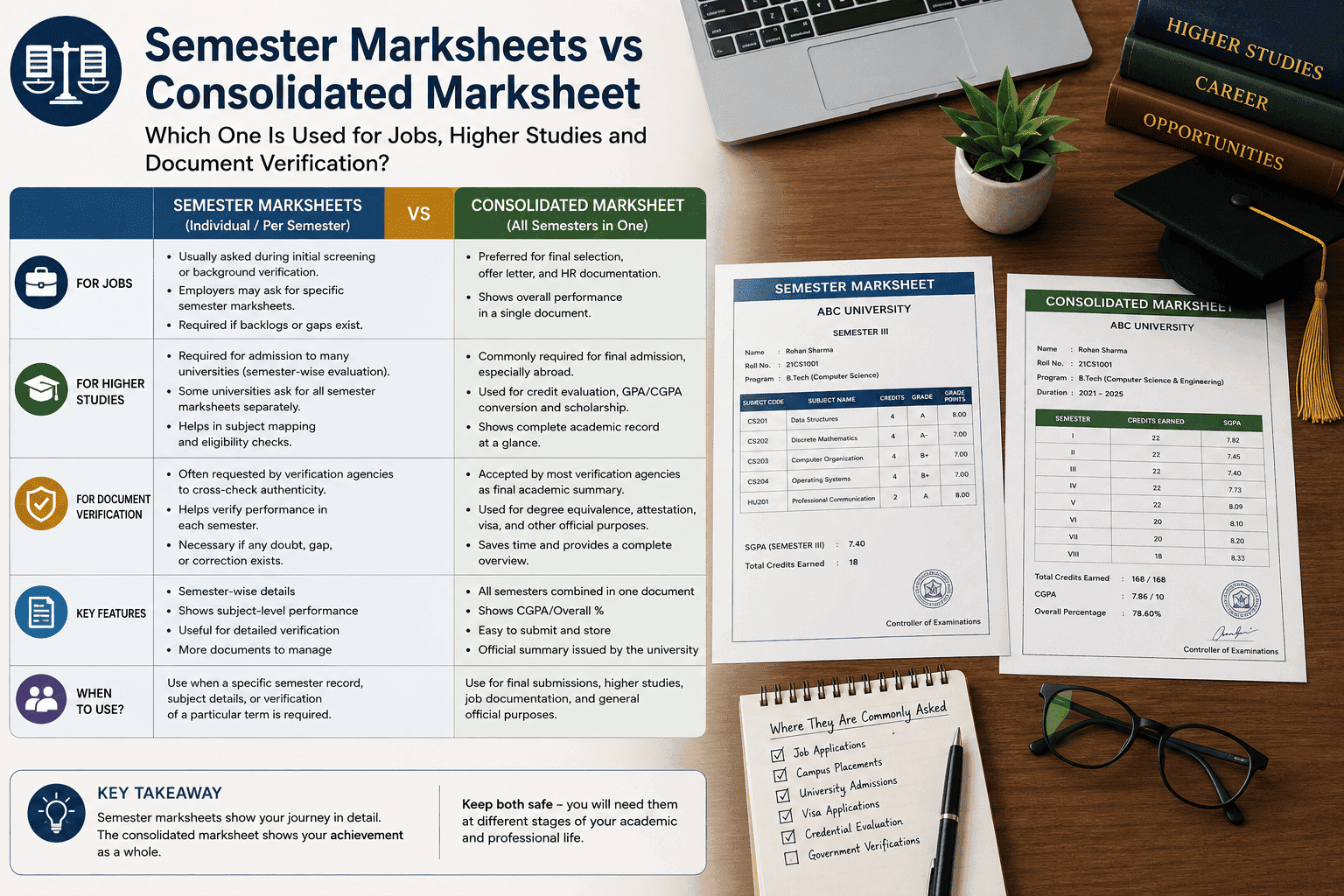
A consolidated marksheet is convenient because it can summarize an entire programme in one document. If it contains all subjects, marks or grades, semesters and the final aggregate or CGPA, it may provide almost everything an organisation needs for a straightforward academic check.
Individual semester marksheets can become important when the recipient needs to see the academic record in greater chronological detail.
Information being checked | Semester marksheets | Consolidated marksheet |
|---|---|---|
Final CGPA or aggregate | May require combining several records | Often readily available |
Every semester separately | Yes | Depends on the format |
Every course or paper | Normally visible for that semester | May or may not list every course |
Semester-wise credits | Often visible in credit-based systems | Depends on university format |
Backlog or failed paper in an earlier semester | Can remain visible in the original semester record | May show only the final cleared result, depending on format |
Progression through the programme | Easier to reconstruct | May provide only the completed academic summary |
One-document overview | No | Yes |
This does not mean that consolidated marksheets are inherently less detailed. Some universities issue consolidated statements containing every paper from every semester. Others provide a much shorter final summary. The actual document must be inspected before deciding whether it contains the information requested.
For Indian Postgraduate Admissions, a Consolidated Marksheet May Be Enough, but Not Always
IIT JAM 2026 provides a useful current example of how an Indian admission process can accept either route.
The JAM 2026 admission brochure asks for qualifying-degree marksheets by academic year. Where the university issues semester marksheets separately, applicants are instructed to combine the relevant semester records. The same instructions state that a consolidated marksheet of all years or semesters can be uploaded if it is available.
That means the consolidated statement can replace multiple semester uploads for this particular stage of JAM admission when it contains the required complete record.
The reason marksheets matter is not simply to confirm that the applicant graduated. JAM's 2026 declaration form asks applicants to provide the courses used to establish that they satisfy programme-specific Minimum Educational Qualifications and tells them to enter those courses according to their marksheets.
For an admission process that requires particular mathematics, science or subject coursework, a degree certificate saying only "Bachelor of Science" may therefore be insufficient.
“Upload Any Available Document” During Application Does Not Mean Documentation Stops There
Application-stage flexibility can also be different from final admission requirements.
IIT Bombay's current postgraduate admission FAQs answer the common question of whether an applicant should upload a consolidated marksheet, final-semester marksheet, seventh and eighth-semester marksheets or degree certificate. At the application stage, candidates can upload documents currently available to them. If selected, however, they must subsequently provide the required qualifying degree or provisional degree documentation and final transcripts or marksheets by the applicable deadline.
This is particularly relevant to final-year students whose Semester VIII result exists but whose consolidated marksheet has not yet been issued. The absence of a consolidated statement during application does not necessarily prevent an application if the institution permits current semester records, but the final document requirement still has to be satisfied later.
Government Recruitment Can Ask for the Degree and the Underlying Marks Record
Government recruitment instructions demonstrate why a degree certificate and marksheets should not be treated as substitutes.
An official ISRO National Remote Sensing Centre recruitment notice requires the relevant graduation certificate together with either a consolidated marksheet or semester-wise marksheets. The same structure is used for postgraduate qualifications where applicable.
In that process, the documents perform two separate functions:
Degree certificate: establishes the qualification.
Consolidated or semester marksheets: establish the academic record supporting that qualification.
UPSC recruitment instructions provide another example of the distinction. In the cited recruitment procedure, the degree or diploma certificate is the primary proof of educational qualification. If that certificate is unavailable, a provisional certificate together with marksheets covering all academic years can be required instead.
The correct document set therefore comes from the exact recruitment notice rather than a general rule such as "government jobs need all semester marksheets."
Private-Sector Jobs: Read the Employer's Request Literally
There is no single private-sector requirement covering Indian employers.
A company may ask only for degree details during the application, collect academic certificates after an offer, request all semester marksheets for a fresher role, or send the qualification to a background-verification agency.
If the employer says "highest qualification certificate", it may be asking primarily for proof that the degree was awarded.
If it says "all academic marksheets", a degree certificate alone is not responsive because it does not show the semester-level academic record.
If it says "consolidated marksheet or all semester marksheets", either route is acceptable according to the wording.
If it simply says "marksheets", do not assume that the final-semester marksheet is sufficient. Check the upload instructions, number of document fields and any accompanying language such as "all semesters", "complete academic record" or "qualifying examination."
Background Verification May Be Checking the Degree, the Marks, or Both
Employment verification is another situation where the purpose of the check matters more than the document name.
Delhi University's current degree-verification procedure allows verification requests from employers, heads of institutions, embassies or high commissions, and recognised Indian or foreign credential-verification agencies. For degree verification, the requesting organisation provides the candidate's academic particulars and a copy of the degree being verified.
Delhi University separately maintains services for attestation or verification of marksheets and for verification of degrees.
Anna University shows the same functional distinction from another angle. Its current genuineness-verification service allows companies, consultancies and embassies to verify degree or provisional certificates for candidates. Anna University also states that it stopped issuing genuineness certificates for consolidated statements of marks or grades through that particular service from 1 May 2025.
So when a background verifier asks for a degree certificate, it may specifically be verifying the award. Supplying six semester marksheets instead does not necessarily answer that verification request.
For Foreign University Applications, Academic Detail Usually Matters More Than the Word “Marksheet”
Foreign universities may not use Indian document terminology at all. The application may simply request an academic transcript or academic record.
Stanford Graduate Admissions currently requires applicants to provide an academic record for every relevant post-secondary institution. Stanford states that the record should give detailed information about the courses taken and grades received, including the institution's grading-scale information. Applicants can initially use an unofficial transcript, while admitted students later have to provide official academic credentials.
Berkeley's current instructions for applicants with an international bachelor's degree similarly ask for a transcript and degree certificate for each post-secondary institution after high school.
This is why an Indian consolidated marksheet can sometimes be useful but should not automatically be called an "official transcript." If the university abroad specifically asks for a transcript, check whether your Indian university issues a separate transcript service and whether direct institutional transmission is required.
A Degree Certificate Alone May Not Show What a Foreign University Needs
A degree certificate normally establishes that a qualification was awarded. It does not necessarily list the subjects, grades and academic progression used to assess an applicant.
Stanford requires academic records that provide course titles and grades, and its post-admission verification process separately addresses transcripts and degree-conferral documents.
Princeton likewise requires transcripts showing course names and grades during graduate admissions. For final verification, if the transcript does not show the degree title and date of award, a separate degree certificate or diploma must accompany it.
These examples illustrate the two evidentiary questions:
What did the student study and how did the student perform? That is an academic-record question.
Was the degree formally awarded? That is a degree-conferral question.
Credential Evaluation Has Its Own Document Rules
Credential evaluators determine their own acceptable document formats and transmission methods.
World Education Services' current 2026 guidance for Indian credentials states that WES accepts both consolidated transcripts and yearly mark sheets, provided they are issued by the degree-granting institution and sent according to WES requirements. WES also tells applicants to include the degree or provisional certificate and the required academic records, while emphasizing that the exact required documents depend on the credential and institution.
This makes two points clear.
First, WES does not impose a universal rule that every Indian applicant must send every individual semester marksheet when an acceptable consolidated academic record exists.
Second, a personal PDF scan can still be insufficient if WES requires records to come from the degree-granting institution or through an approved electronic arrangement.
Scholarships Can Require Academic Records Even When You Already Have a Degree
A scholarship committee may need to evaluate academic performance rather than merely verify that a qualification exists.
The Japanese Government MEXT research scholarship documentation provides a clear example. Its academic-record instructions require transcripts showing the grading scale and the grades earned in the subjects studied. The official guidance expressly states that a degree or graduation certificate that merely establishes graduation does not substitute for the academic transcript.
The Embassy of Japan in India is currently accepting the 2027 MEXT research-student framework and separately identifies both academic eligibility and the requirement for candidates to obtain their marksheet and degree by the prescribed stage.
Again, proof of graduation and evidence of academic performance serve different purposes.
When Semester Marksheets Are More Useful Than the Consolidated Record
Individual semester records become particularly useful when the consolidated document omits information that the receiving organisation needs.
That can happen when a consolidated statement gives only semester SGPAs, overall CGPA and final classification rather than listing every subject. A postgraduate programme checking whether you studied Mathematics for two semesters, for example, may need the underlying semester records or a transcript containing course titles.
Semester marksheets can also reveal the chronology of a backlog or repeated paper. Suppose Semester III originally contains:
Course | Original status |
|---|---|
Statistics III | F / Reappear |
A later marksheet may show that Statistics III was successfully cleared. A consolidated statement might display only the final successful grade, depending on the university's format.
If a receiving organisation specifically asks about attempts, backlogs or complete semester history, the original semester-wise records can therefore contain relevant information that a final summary does not.
When the Consolidated Marksheet Is the Better Document
A consolidated marksheet is often the cleaner choice when the organisation simply wants a complete summary of the finished degree and expressly accepts it.
Instead of uploading eight separate files, the student may be able to provide one document showing:
Possible consolidated information | Why useful |
|---|---|
Programme and student identification | Identifies the qualifying degree |
Subjects across the degree | Can establish academic coverage where fully listed |
Semester or year results | Shows programme-wide performance |
Final CGPA or aggregate percentage | Allows eligibility checks |
Total credits or classification | Can establish completion requirements |
JAM 2026's acceptance of a consolidated marksheet in place of separately combined semester records is a current practical example.
What If the Consolidated Marksheet Does Not List Every Subject?
Do not assume the word "consolidated" guarantees a complete course-by-course record.
If the recipient needs subject-level information and your consolidated document only shows semester totals, provide the semester marksheets or an official transcript according to the recipient's instructions.
This is particularly important for:
programme-specific prerequisite verification;
credit evaluation;
foreign university admissions requiring course titles and grades;
scholarships evaluating academic performance;
requests specifically asking for every examination or semester record.
That is the same reason Stanford specifies that academic records must show the courses taken and grades received rather than accepting proof of degree alone.
What If One or More Semester Marksheets Are Missing?
If the organisation expressly accepts a consolidated marksheet containing the complete required record, the missing individual copy may not prevent submission.
If it specifically requires all semester marksheets, however, the appropriate solution is normally to obtain a duplicate semester marksheet or confirm whether the recipient will accept the consolidated statement instead.
Do not silently omit Semester III from a set labelled "all semester marksheets."
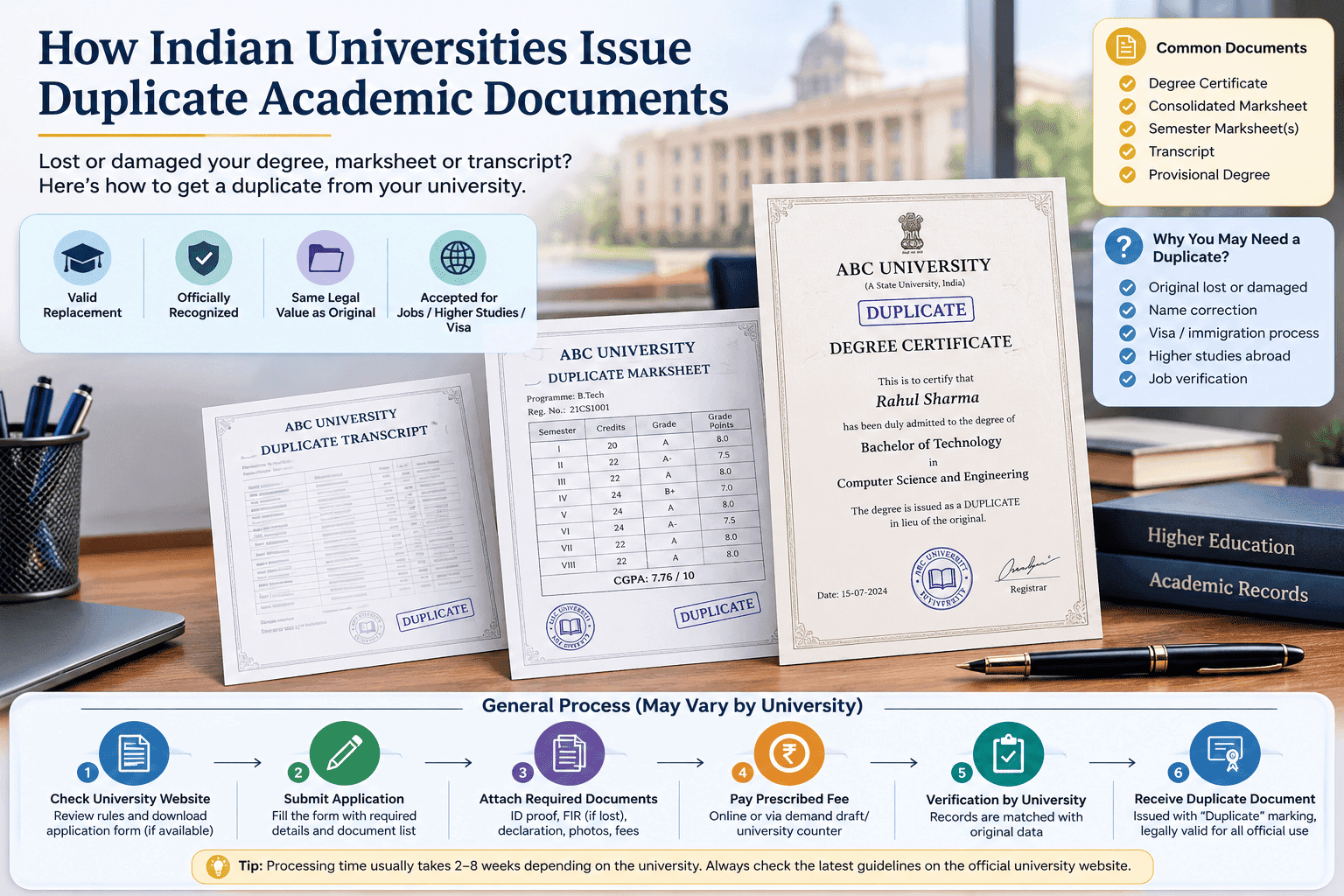
Universities commonly treat duplicate marksheets as separate official services. Delhi University, for example, maintains a distinct Duplicate Mark Sheet service as well as separate transcript and degree services.
What If the Final Semester Result Is Out but the Consolidated Marksheet Is Not?
This is common for students applying immediately after completing a degree.
Use the documents currently accepted by the receiving institution. IIT Bombay's postgraduate admission FAQs explicitly allow applicants to upload available documentation initially, with final transcripts or marksheets and qualification documentation required later if selected.
A final-semester marksheet should not, however, be described as the complete degree record merely because it contains a CGPA. The recipient may still require earlier semesters or a later consolidated statement.
What Does “Upload All Marksheets” Usually Mean?
The safest interpretation is that the organisation wants the complete marksheet record for the qualification, unless its instructions say that a consolidated statement can replace them.
Check four things before uploading:
1. Does the instruction say “all semesters” or “all years”? If yes, provide the complete set unless an alternative is expressly allowed.
2. Does it say “consolidated marksheet or semester-wise marksheets”? Either format is acceptable under that instruction.
3. Does it say “transcript”? Do not automatically substitute a consolidated marksheet. Check the institution's transcript requirement.
4. Does it ask only for proof of qualification? A degree or provisional certificate may be the relevant document, subject to the stated requirement.
ISRO's cited recruitment notice is a good example of precise wording: it expressly asks for the graduation certificate plus either the consolidated marksheet or semester-wise marksheets.
Why the Degree Certificate Alone Is Sometimes Not Enough
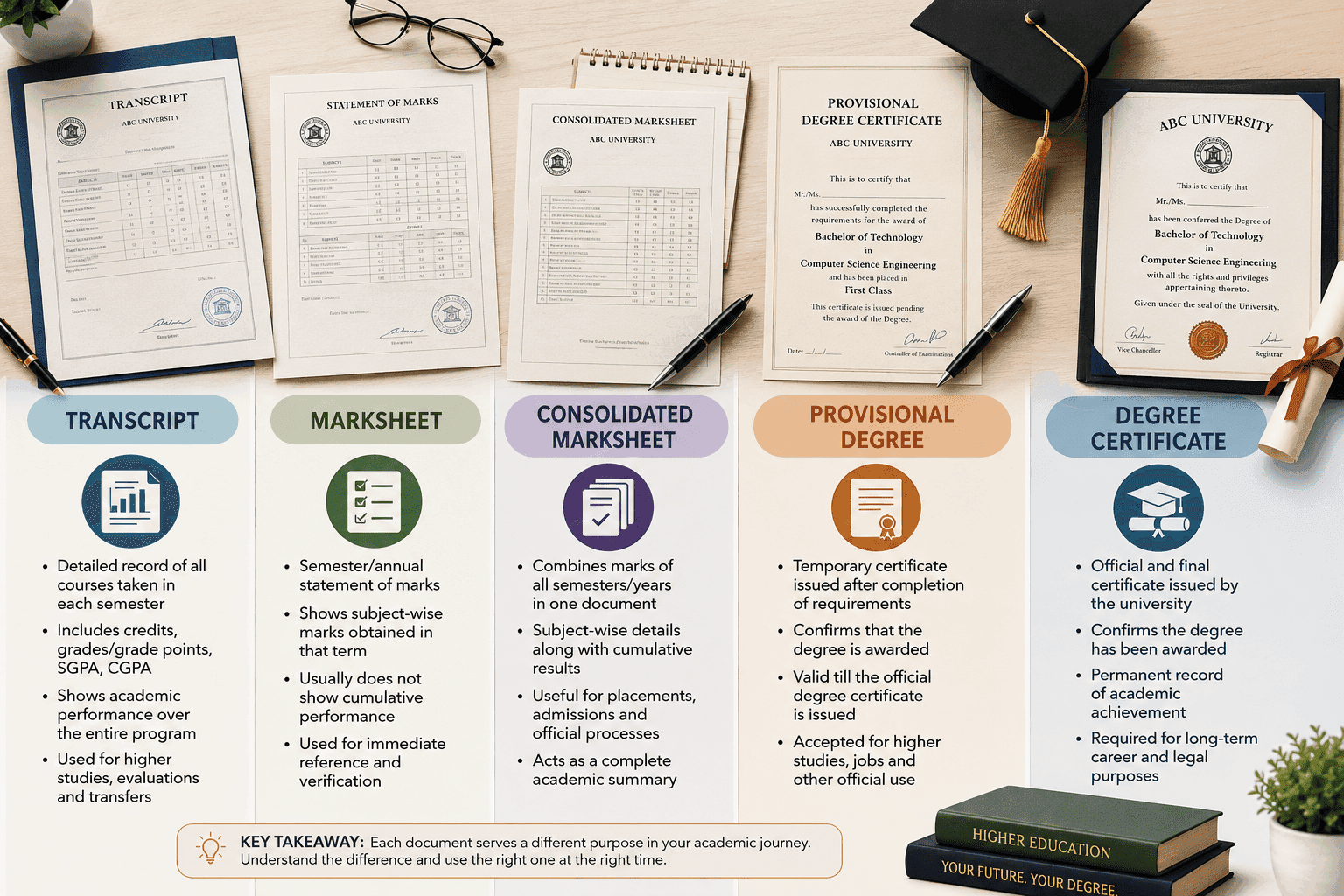
A degree certificate can establish that a Bachelor of Technology, Bachelor of Commerce, Master of Science or another qualification was awarded. It may tell the recipient nothing about individual subjects, grades, credits, attempts or aggregate performance.
That is sufficient when the only question is:
“Did this person receive this degree?”
It is not necessarily sufficient when the question is:
“Did this applicant obtain at least 60%?”
“Did this student complete Mathematics?”
“What grades did the applicant receive in each course?”
“Was this prerequisite subject studied for the required period?”
“What was the applicant's complete academic performance?”
This is why formal processes frequently request both qualification evidence and academic records. The current ISRO recruitment example asks for both, WES distinguishes the degree certificate from academic records, and international universities such as Stanford and Princeton separately address transcripts and degree-conferral evidence.
Use the Receiving Organisation's Requirement, Not a Generic Document Rule
When choosing between semester marksheets and a consolidated marksheet, start with the request rather than the documents you happen to have.
If the recipient needs... | Look first for... |
|---|---|
Complete final academic summary | Consolidated marksheet, if accepted and sufficiently detailed |
Every semester's academic history | Individual semester marksheets |
Course-by-course institutional academic record | Official transcript or the specific academic record requested |
Proof that the qualification was awarded | Degree certificate or accepted provisional degree |
Authentication of the qualification | University verification process requested by the employer or agency |
The practical rule is therefore not "always submit all semester marksheets" or "a consolidated marksheet replaces everything." Submit the academic record that answers the receiving organisation's question. Where the instructions are ambiguous, confirm whether "marksheets" means every semester, a consolidated statement, or either. That is more reliable than assuming that documents with overlapping academic information are automatically interchangeable.