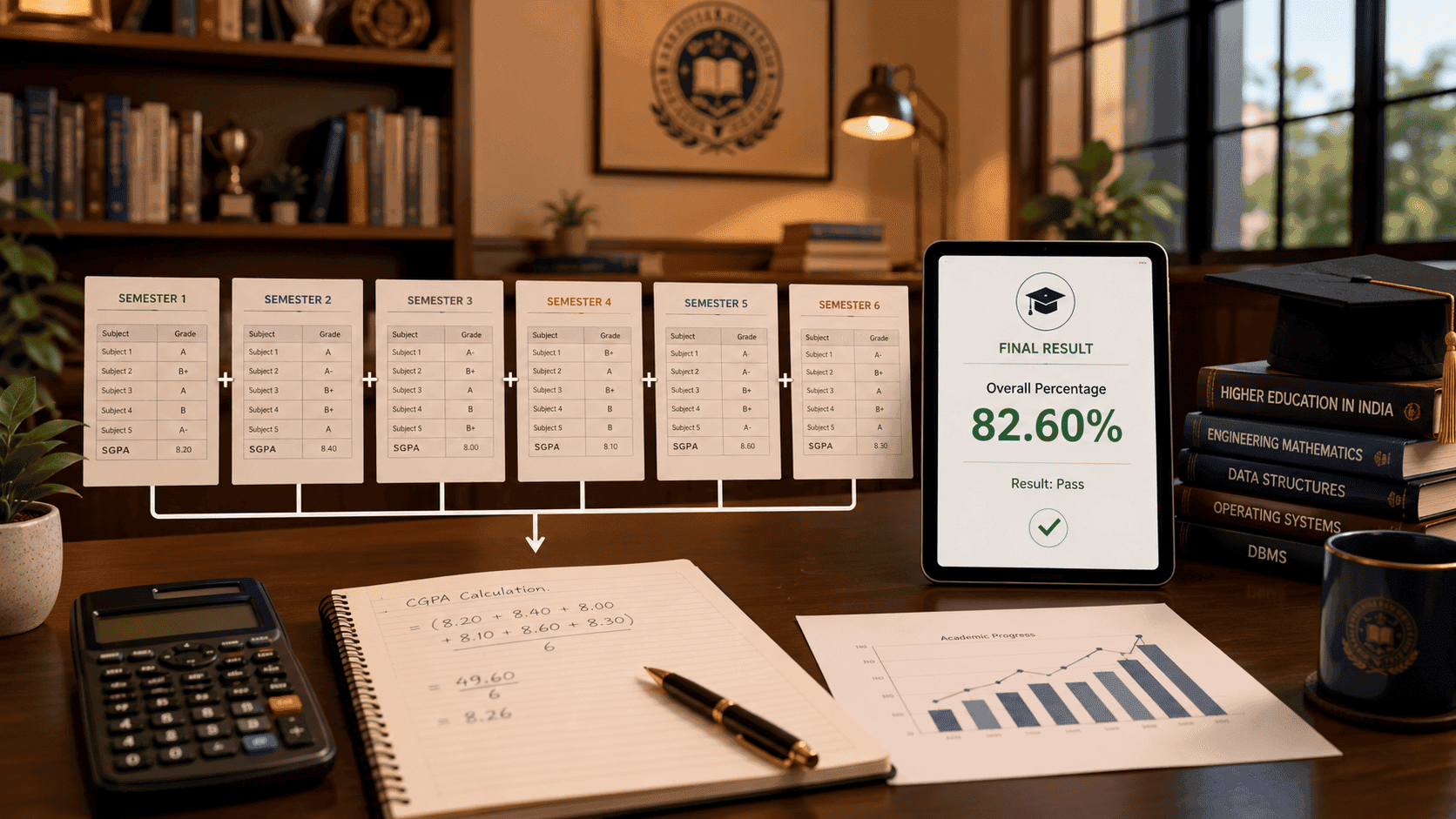
Your overall degree percentage should be calculated from all semesters using the method prescribed by your university. If your marksheets contain actual marks, the usual marks-based calculation is total marks obtained across the applicable semesters divided by the total maximum marks. If your university uses SGPA and CGPA, the correct route may instead be to calculate the final credit-weighted CGPA and then apply the university's official CGPA-to-percentage rule.
The important point is that adding semester percentages and dividing by the number of semesters is not always correct. It works when all semesters have equal weight, but it can produce the wrong result when semester maximum marks or credits differ.
Which Calculation Should You Use?
What your academic record shows | Calculation to check |
|---|---|
Marks obtained and maximum marks for every semester | Add all obtained marks and all maximum marks, then calculate the percentage |
Only semester percentages, but semester maximum marks are known | Use a weighted percentage based on each semester's maximum marks |
SGPA and semester credits | Calculate the credit-weighted CGPA, then use the university's official percentage conversion if one exists |
Final CGPA already printed on the consolidated grade sheet | Use the university's official CGPA-to-percentage formula or the percentage already printed by the university |
Universities can prescribe different evaluation and conversion rules. The UGC Minimum Standards of Instruction Regulations, 2025 require HEIs using grades to establish a method for conversion between grades and percentages rather than prescribing one national multiplication factor. (ugc.gov.in)
Method 1: Calculate Overall Percentage From Marks in All Semesters
If your degree is reported primarily through marks, the most direct calculation is:
Overall Degree Percentage = Total Marks Obtained in All Applicable Semesters ÷ Total Maximum Marks × 100
The word applicable matters. Use the subjects and semesters that your university includes in the final degree result. Do not remove a semester, practical, internal assessment or other component simply because its marks are lower unless the university's regulations exclude it.
Worked Example: Six-Semester Degree
Consider this fictional three-year degree record:
Semester | Marks Obtained | Maximum Marks | Semester Percentage |
|---|---|---|---|
Semester I | 438 | 600 | 73.00% |
Semester II | 480 | 600 | 80.00% |
Semester III | 510 | 650 | 78.46% |
Semester IV | 455 | 550 | 82.73% |
Semester V | 528 | 650 | 81.23% |
Semester VI | 504 | 600 | 84.00% |
Total | 2,915 | 3,650 |
The overall degree percentage is:
2,915 ÷ 3,650 × 100 = 79.8630%
If the applicable university or application requires two decimal places:
Overall Degree Percentage = 79.86%
This result comes from the complete marks record rather than treating each semester as equally weighted.
Why Averaging Semester Percentages Can Be Wrong
Using the same six semesters, the simple average of the semester percentages is:
(73.00 + 80.00 + 78.46 + 82.73 + 81.23 + 84.00) ÷ 6 = approximately 79.90%
The marks-based result was 79.86%.
The values differ because the semesters do not all have the same maximum marks. Semester III and Semester V are each worth 650 marks, while Semester IV is worth only 550 marks. Giving all six percentages equal weight changes the result.
When is a simple semester average valid?
If every semester carries exactly the same maximum marks, then averaging semester percentages produces the same result as adding all marks.
For example:
Semester | Marks | Maximum | Percentage |
|---|---|---|---|
I | 420 | 600 | 70% |
II | 480 | 600 | 80% |
III | 510 | 600 | 85% |
IV | 450 | 600 | 75% |
Average of percentages:
(70 + 80 + 85 + 75) ÷ 4 = 77.50%
Total-marks method:
1,860 ÷ 2,400 × 100 = 77.50%
Both methods agree because every semester has the same maximum of 600 marks.
If You Only Have Semester Percentages
If the marks themselves are unavailable but you know both the percentage and maximum marks for each semester, you can reconstruct the weighted overall percentage:
Overall Percentage = Σ (Semester Percentage × Semester Maximum Marks) ÷ Σ Semester Maximum Marks
When percentages are entered as whole percentage values, divide appropriately by 100 while reconstructing the semester marks.
For example:
Semester | Percentage | Maximum Marks |
|---|---|---|
I | 70% | 500 |
II | 80% | 700 |
Equivalent marks:
Semester I: 70% of 500 = 350
Semester II: 80% of 700 = 560
Total:
910 ÷ 1,200 × 100 = 75.83%
A simple average would give 75%, which is not the same result because Semester II carries more marks.
Some Universities Define the Final Result as an Aggregate Across All Courses
A marks-based programme may expressly use the aggregate of all courses rather than an average of semester percentages.
Delhi University's current LL.B. examination information provides a clear example. A candidate must pass all 30 courses across six terms, and classification is based on the aggregate in all 30 courses taken together. A candidate securing at least 60% in that aggregate is awarded First Division, while the subsequent classification bands are also based on the combined course aggregate. (clc.du.ac.in)
This illustrates why a student should look for terms such as aggregate marks, all courses taken together, combined result or overall marks in the applicable examination regulation.
Method 2: Overall Degree Result From SGPA and Semester Credits
If your marksheet reports SGPA rather than a conventional aggregate of raw marks, do not convert each SGPA separately into a percentage and then average those percentages unless your university specifically tells you to do so.
The correct intermediate calculation may be the final CGPA:
CGPA = Σ (Semester Credits × SGPA) ÷ Σ Semester Credits
University of Kashmir's current two-year Master's statutes use this credit-weighted approach. They define CGPA as the cumulative average taking the total credits in each semester into account. (egov.uok.edu.in)
Worked Example With Unequal Semester Credits
Semester | Credits | SGPA | Credits × SGPA |
|---|---|---|---|
I | 20 | 7.60 | 152.00 |
II | 22 | 8.00 | 176.00 |
III | 18 | 8.50 | 153.00 |
IV | 24 | 8.30 | 199.20 |
Total | 84 | 680.20 |
CGPA:
680.20 ÷ 84 = 8.0976
If reported to two decimal places:
CGPA = 8.10
The simple average of the four SGPAs would be:
(7.60 + 8.00 + 8.50 + 8.30) ÷ 4 = 8.10
In this particular example the rounded values happen to be the same, but that is coincidence. With more unequal credits or different SGPAs, the results can diverge. The university's credit-weighted method remains the correct method where its regulation requires it.
Method 3: Convert the Final CGPA Into Degree Percentage
After calculating the overall CGPA, the next question is whether the university officially converts that CGPA into percentage.
This is a separate calculation.
For example, Anna University's Academic Regulations 2025 for the affiliated B.Arch. programme state that CGPA represents overall performance across courses from the first semester onwards and that the consolidated grade sheet prints percentage using:
Percentage of Marks = CGPA × 10 (cac.annauniv.edu)
Under that particular regulation, if the final CGPA were 8.10:
Overall Degree Percentage = 8.10 × 10 = 81.00%
This is correct for the programme and regulation covered by that Anna University source. It is not a formula that should be applied automatically to every Indian degree.
Why You Should Convert the Final CGPA, Not Every Semester Separately
Suppose a university calculates final CGPA from semester credits and then specifies a CGPA-to-percentage formula.
The correct sequence is:
Semester grades → SGPA → credit-weighted final CGPA → official percentage conversion
It is generally unsafe to do this instead:
SGPA I → percentage
SGPA II → percentage
SGPA III → percentage
average the percentages
That shortcut can discard the credit weighting built into the university's cumulative calculation.
Anna University's 2025 B.Arch. regulation makes this sequence particularly clear: GPA is calculated as a credit-weighted semester measure, CGPA is calculated cumulatively across the relevant courses, and the consolidated grade sheet then converts the earned CGPA into percentage. (cac.annauniv.edu)
A Final Grade Sheet May Already Contain the Overall Percentage
Before calculating anything manually, check your consolidated grade sheet or final transcript.
Some universities print both the overall CGPA and its percentage equivalent.
The University of Calicut's amended Regulations for Integrated Programmes 2020, published in 2026, provide a useful example. The final grade sheet for the ten-semester integrated programme is required to include the overall CGPA for Semesters I to X, percentage of marks and overall letter grade. The same regulations separately preserve foundation-level and advanced-level results. (docs.uoc.ac.in)
If an official consolidated record already gives your overall degree percentage, use that value when an application asks for the university-issued percentage rather than creating a different number through an independent calculation.
Do Internal Assessment and Practical Marks Count?
If those marks form part of the marks awarded for the applicable courses, they should not normally be removed when calculating the aggregate.
For example, University of Delhi's examination rules have expressly treated internal assessment marks as part of the marks used with semester or university examination performance for determining results in programmes where that ordinance applies. (kmc.du.ac.in)
The exact split between internal assessment, end-semester examination, practical, project or other components is programme-specific. Use the final course total printed by the university where available rather than trying to rebuild the marks from only one component.
What About Backlogs, Reappear Exams and Improvement Marks?
Do not add the marks from both the original failed attempt and the later successful attempt unless the university's rules specifically require that treatment.
A university may replace a grade, retain particular internal marks, exclude unsuccessful grades from CGPA, limit improvement results or use another method. These rules can materially affect the final aggregate.
The safest source is the final marksheet or consolidated grade sheet after the reappear or improvement result has been incorporated.
Similarly, if a transcript already prints a final CGPA after all required courses have been cleared, use that official cumulative value rather than reconstructing it from outdated semester grade cards.
Overall Percentage, Final-Year Percentage and Aggregate Percentage Are Not the Same
Term | What it normally refers to |
|---|---|
Semester Percentage | Performance within one semester |
Final-Year Percentage | Performance in only the final academic year |
Overall / Degree Percentage | Performance across the complete degree under the university's calculation rule |
Aggregate Percentage | Combined percentage of the marks or courses specified by the institution or application |
An employer or university asking for overall graduation percentage normally does not mean only the final semester unless its instructions explicitly say so.
Likewise, an admission rule may sometimes ask for marks in particular years, particular subjects or only a qualifying component. In that case, follow the receiving institution's definition of aggregate rather than automatically submitting your complete degree percentage.
How to Calculate Your Degree Percentage Without Using the Wrong Method
Start with the final academic record and identify which system your university uses:
If all semesters show marks and maximum marks: add all applicable obtained marks and maximum marks.
If semester maximum marks differ: do not simply average semester percentages.
If the programme uses credits and SGPA: calculate or use the official credit-weighted CGPA.
If the consolidated grade sheet already prints CGPA: do not recreate it from rounded SGPAs unless necessary.
If percentage must be obtained from CGPA: use only the conversion formula applicable to your university, programme and batch.
If an official final percentage is already printed: use that value unless the receiving organisation asks for another calculation.
The most reliable calculation is therefore not necessarily "add six semester percentages and divide by six." For a marks-based degree, the correct result can come from the combined marks and combined maximum marks. For a credit-based degree, it can come from the cumulative credit-weighted CGPA followed by the university's own percentage conversion. The marksheet structure and applicable university regulation determine which route is academically correct.