India has a national framework for academic credits, but it does not have one national grading rule that makes every university's marks, grades, SGPA, CGPA and percentage interchangeable.
The University Grants Commission sets important regulatory standards for credit-based higher education, multiple entry and exit, the Academic Bank of Credits and minimum qualification structures. At the same time, the current UGC regulations explicitly leave universities and autonomous colleges substantial control over curriculum design, course-level credits, assessment weightage, attendance and conversion between grades and percentages.
This distinction matters whenever a student tries to transfer credits, calculate CGPA, convert CGPA into percentage or compare grades from two universities. A rule appearing in a UGC framework may establish the national architecture. The number printed on a student's transcript, however, can still depend on the university's own statutes, ordinances and programme regulations.
What is standardized nationally and what is still decided by the university?
Academic area | National UGC or NCrF position | What the university or HEI still decides |
|---|---|---|
Credit framework | NCrF provides a common credit architecture. Overall, 1 credit corresponds to 30 notional learning hours and 40 credits correspond to 1,200 notional learning hours in a year. | Regulators and autonomous institutions may prescribe different learning-hour arrangements for theory, practical and experiential components. Institutions can also include learning beyond the standard 40-credit annual reference. |
UG qualification structure | The 2025 UGC regulations use 120 credits for a 3-year undergraduate degree and level 6 with 160 credits for a 4-year Honours or Honours with Research degree. | The detailed programme structure, distribution among major, minor, skill, multidisciplinary and other components can differ. Some university programmes require additional credits. |
Academic Bank of Credits | ABC provides the formal system for recognition, accumulation, transfer and redemption of eligible academic credits. | The degree-awarding HEI determines which credits satisfy its programme requirements and which core components must be completed. |
External credits | Under the ABC regulations, at least 50% of the credits must be earned from the HEI awarding the degree, diploma or certificate. | The awarding HEI specifies the required credits in the core subject and its rules for accepting credits earned elsewhere. |
Assessment | UGC establishes the regulatory framework and requires appropriate assessment of learning outcomes. | The university's academic body determines tests, seminars, presentations, fieldwork, examination components and their weightage. |
Attendance | The 2025 regulations recognize attendance as an institutional academic requirement. | HEIs decide the minimum attendance requirement for different programmes with approval of their statutory bodies. |
Grades and percentage | UGC permits credit and grade-based systems and requires HEIs using grades to maintain a way of converting grades and percentages. | The HEI must work out and adopt its own conversion table. The current UGC regulation does not prescribe one universal CGPA-to-percentage multiplication factor. |
SGPA and CGPA implementation | Credit-weighted grade-point averages are widely embedded in UGC credit frameworks. | Exact grade bands, passing grades, rounding, treatment of failed courses, absent grades and programme-specific rules must be checked in the applicable institutional regulation. |
The most important line for students using CGPA calculators appears in Regulation 9 of the UGC Minimum Standards of Instruction for the Grant of Undergraduate Degree and Postgraduate Degree Regulations, 2025: HEIs are required to work out and adopt a table for conversion of grades into percentages and vice versa. The same regulation leaves evaluation units and their weightages to the appropriate academic body of the university.
That is why there is no defensible national rule saying that every Indian student's percentage equals CGPA multiplied by 9.5, 10 or any other fixed number.
The documents are not all the same type of rule
One source of confusion is that UGC regulations, national frameworks and university ordinances are often discussed as though they have identical legal and academic functions. They do not.
Document | What it does | How it should be interpreted |
|---|---|---|
UGC Minimum Standards Regulations, 2025 | Establish current minimum regulatory standards for undergraduate and postgraduate degrees. | This is a UGC regulation. It applies to universities and covered institutions specified in the regulation. |
UGC Academic Bank of Credits Regulations, 2021 | Regulate the recognition, accumulation, transfer and redemption mechanism for academic credits through ABC. | These are regulations, not simply an explanatory model for universities to copy. |
National Credit Framework, 2023 | Creates a common credit architecture spanning academic, vocational, skill and experiential learning. | NCrF expressly describes itself as an enabling framework and says it should not be construed as a regulation. Regulators and autonomous institutions can issue detailed implementation rules within it. |
University statutes, ordinances and programme regulations | Turn the broader framework into operational academic rules for a particular institution, programme or batch. | These are where students often find the actual grading table, pass criteria, attendance rule, course structure and conversion method applicable to their result. |
The 2025 UGC regulations themselves reflect this layered system. They incorporate the NCrF into the current definition of credit, but state that curriculum content, curriculum transaction, educational technology, timing and continuous evaluation methods are to be decided by universities and autonomous colleges within the relevant national frameworks.
What does one academic credit mean under the current framework?
The National Credit Framework uses 1,200 notional learning hours for 40 credits. On that overall basis:
1 credit = 30 notional learning hours
The word notional is important. These are not necessarily 30 hours sitting in a classroom. NCrF says learning hours can include classroom instruction, laboratory work, tutorials, assignments, projects, examinations, field visits, internships, apprenticeships, on-the-job training, experiential learning and other assessed learning activities. It also explicitly allows regulators or autonomous institutions to prescribe different hour arrangements for theory, practical and experiential learning.
Why older documents may describe a credit differently
The 2021 ABC regulations contain an earlier contact-based definition. They describe one credit as one hour of theory or tutorial, or two hours of laboratory work per week, over a semester of 13 to 15 weeks. Internship credits were described separately.
NCrF was notified later and uses the broader 30-notional-learning-hours approach. The 2025 UGC Minimum Standards regulations then define a credit by reference to NCrF.
These provisions should therefore be read in their date and regulatory context rather than combined into a made-up equation such as "one credit always means 15 classroom hours" or "one credit always means exactly 30 lecture hours." NCrF's 30 hours describe the overall notional learning volume, not necessarily 30 face-to-face teaching hours.
How many credits are associated with an undergraduate degree?
Under the current UGC Minimum Standards regulations, a 3-year undergraduate degree corresponds to 120 credits. A 4-year undergraduate degree with Honours or Honours with Research is placed at level 6 with 160 credits. The regulations also provide the multiple-exit structure for the earlier stages.
Exit or qualification | UGC 2025 credit position | Additional condition stated in the regulation |
|---|---|---|
After Year 1 | 40 credits | UG Certificate requires a minimum 4-credit skill-enhancement course over and above the 40 credits. |
After Year 2 | 80 credits | UG Diploma requires a minimum 4-credit skill-enhancement course over and above the 80 credits. |
After Year 3 | 120 credits | Undergraduate degree at NCrF level 5.5. |
After Year 4 | Level 6, normally associated with 160 credits | Undergraduate Honours or Honours with Research, subject to the applicable programme requirements. |
The regulations permit re-entry before the applicable credits expire, subject to the prescribed maximum duration of seven years for the relevant undergraduate pathways.
These figures should not be interpreted as proof that every university's semester table must contain exactly 20 credits or that every 4-year curriculum must visibly total only 160 course credits. NCrF itself permits additional courses and credits beyond its 40-credit annual reference.
A primary-source example: University of Kashmir requires more than the national 40-credit-per-year reference
The University of Kashmir's FYUGP statutes, updated through April 2026, provide a useful example of why the national framework and institutional curriculum should not be treated as identical documents.
The university's table lists 52 credits for its 1-year certificate stage, 94 for the 2-year diploma stage, 134 for the 3-year degree and 174 credits for the 4-year Honours or Honours with Research programme. It also sets programme-specific requirements for major, minor, multidisciplinary, ability enhancement, value-added and skill-enhancement courses.
That does not invalidate the national credit architecture. It demonstrates the flexibility built into it. NCrF uses 40 credits per 1,200 notional learning hours as its broad annual reference and permits additional learning to carry additional credits. The university then constructs its own programme requirements within the regulatory system.
What the Academic Bank of Credits actually standardizes
The Academic Bank of Credits is often described too loosely as a system that allows students to take credits anywhere and automatically apply them to a degree. The 2021 regulations do not support that interpretation.
ABC is the national mechanism for handling credit recognition, accumulation, transfer and redemption. Credits are deposited through registered HEIs. The regulations specifically state that ABC does not accept students' credit documents directly as substitutes for institutional transmission.
ABC term | Meaning in practical terms |
|---|---|
Credit recognition | Eligible credits earned through a registered HEI are recognized and transmitted to the ABC system by that HEI. |
Credit accumulation | Credits earned through eligible courses can be collected in the student's Academic Bank Account. |
Credit transfer | Credits can move through the formal ABC mechanism between registered HEIs, subject to the applicable academic rules. |
Credit redemption | Accepted accumulated credits are used toward the credit requirements of an academic award. |
The distinction becomes clearer in Regulation 5.6 of the ABC regulations. The required credits and essential components of study for a degree, diploma or certificate remain those prescribed by the registered HEI. ABC authenticates and manages the credit record, but does not replace the statutory authority of the university awarding the qualification.
A credit appearing in ABC is not the same as automatic degree equivalence
Under the implementation provisions of the ABC regulations, registered HEIs are expected to amend their ordinances to address course requirements, interdisciplinary courses, credit transfer, acceptance of credits from other approved institutions and the nature of grades awarded. A student using the ABC flexibility must earn at least 50% of the credits from the institution awarding the degree, diploma or certificate, and must also satisfy the core-credit requirement specified by that institution.
ABC credits also have a defined shelf life not exceeding seven years, as specified under the applicable rules and subject to acceptance by the HEI awarding the qualification. Once a credit is redeemed toward a formal qualification, it is debited and cannot be reused for another formal academic qualification.
Worked example: 32 ABC credits do not automatically remove 32 credits from any degree
Assume a student moves to a programme requiring 160 credits and already has 32 verified credits in ABC from another registered HEI.
The arithmetic is simple only after the university approves the academic equivalence. If all 32 credits are accepted into categories required by the new programme:
160 required credits - 32 accepted credits = 128 credits still to be completed
But the calculation cannot be done merely because the account contains 32 credits. The degree-awarding HEI may determine that some credits fit an elective requirement but not the major, that a course does not satisfy its required learning outcomes, or that particular core courses must still be completed. The ABC regulations specifically preserve the awarding institution's control over these requirements.
There is also a second constraint. Under the ABC framework, at least half of the credits must come from the institution awarding the qualification. For a 160-credit award, that statutory floor is:
160 × 50% = 80 credits from the degree-awarding HEI
The 80-credit figure does not mean that the other 80 are automatically transferable. It is a ceiling created by one condition, not an entitlement to have every outside credit accepted. Core requirements and the institution's approved credit-acceptance rules still apply.
Grading is where national standardization is much weaker
Terms such as grade point, SGPA and CGPA are now common across Indian higher education, but identical terminology does not mean identical grading.
The 2025 UGC regulations make the institutional responsibility unusually clear. The appropriate academic body determines evaluation components and their weightage, while each HEI must develop its own table for converting grades into percentages and percentages into grades.
This leaves room for variation in marks bands, letter names, minimum passing grade, decimal grade points, treatment of absences, rounding and percentage conversion.
Original comparison dataset: the same 10-point language can produce different results
The following comparison uses current or explicitly dated primary institutional rules rather than assuming that a generic "UGC 10-point scale" applies identically everywhere.
Source and scope | Selected grading rule | What it demonstrates |
|---|---|---|
University of Calcutta, 5-year B.A. LL.B. Regulations, 2025 | 90 to 100 = O, grade point 10; 80 to below 90 = A+, 9; 70 to below 80 = A, 8; 30 to below 40 = P, 4; below 30 = F, 0. | A specific university programme has its own percentage bands, pass threshold and grade terminology. |
NUSRL Ranchi examination rules | 90% and above = O, 10; 85 to 89 = A+, 9; 80 to 84 = A, 8.5; 75 to 79 = B+, 8. | A 10-point system does not even require every institution to use only whole-number grade points. |
O.P. Jindal University, grading effective for 2024 batch onwards | O, grade point 10, applies above 90 up to 100; A+, grade point 9, applies above 80 up to 90. | The boundary at exactly 90 can differ from another university's table, and the university separately preserves an older system for earlier batches. |
University of Kashmir FYUGP statutes, updated April 2026 | A minimum qualifying grade P or grade point 4 is required in each course. The statutes separately prescribe CGPA-to-percentage conversion by multiplying CGPA by 10. | Passing requirements and percentage conversion can be directly specified by the university's own statutes. |
One mark can therefore receive different grades
Take a score of exactly 90%.
Under the University of Calcutta's 2025 B.A. LL.B. regulation, 90 falls in the 90 to 100 band and receives O with grade point 10. At O.P. Jindal University, the grading rule effective from the 2024 batch places O above 90, while the A+ band extends through 90. A score of exactly 90 therefore falls into A+ with grade point 9 under that published table.
The mark has not changed. The institutional grading rule has.
This is why a marks-to-grade converter that asks only for a percentage, without asking for the university, programme or regulation year, cannot reliably return an official academic grade.
SGPA and CGPA are credit-weighted calculations
A conventional credit-based SGPA calculation uses the credits assigned to each course as weights:
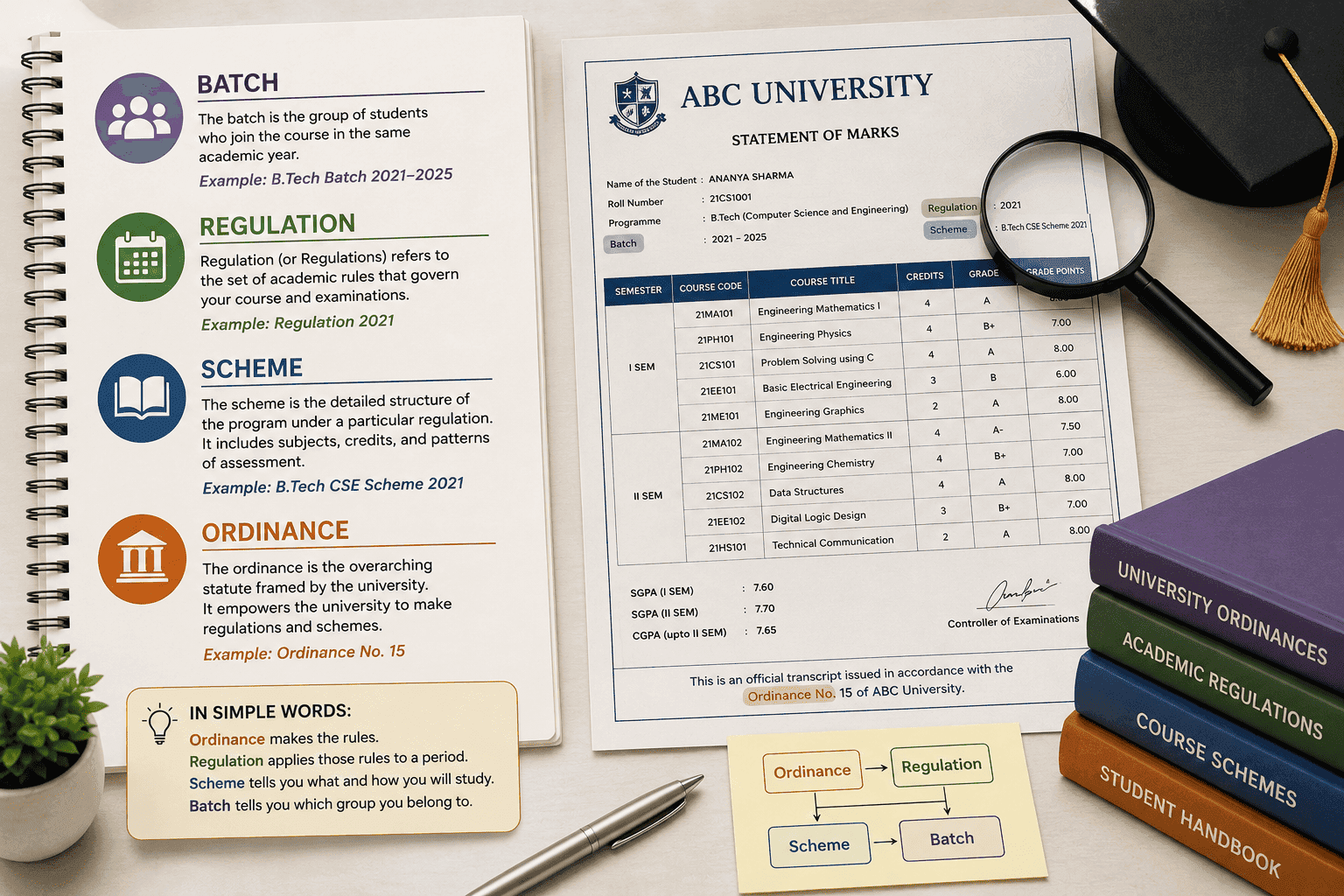
SGPA = Σ(Course Credit × Grade Point) ÷ Σ(Course Credits)
The University of Calcutta's 2025 B.A. LL.B. regulations, for example, use this credit-weighted method and require SGPA and CGPA to be expressed to two decimal places for that programme.
Worked SGPA calculation
Course | Credits | Grade point | Credit points |
|---|---|---|---|
Course 1 | 4 | 9 | 36 |
Course 2 | 4 | 8 | 32 |
Course 3 | 3 | 7 | 21 |
Course 4 | 2 | 10 | 20 |
Course 5 | 2 | 6 | 12 |
Total | 15 | 121 |
SGPA = 121 ÷ 15 = 8.0667
If the applicable university rule requires reporting to two decimal places, the reported SGPA would be 8.07. The rounding step should not be assumed for every university unless its regulation or result system specifies it.
CGPA should also respect semester credit weights
Suppose a student's three semesters have different credit loads:
Semester | Semester credits | SGPA | Weighted value |
|---|---|---|---|
Semester 1 | 20 | 7.80 | 156.00 |
Semester 2 | 22 | 8.20 | 180.40 |
Semester 3 | 18 | 8.50 | 153.00 |
Total | 60 | 489.40 |
CGPA = 489.40 ÷ 60 = 8.1567
Rounded to two decimal places, where that is the institution's rule, the result is 8.16.
Simply calculating (7.80 + 8.20 + 8.50) ÷ 3 would give a different result because the semesters do not carry equal credits. A CGPA calculator must therefore know the applicable institutional formula and credit weights, not merely the SGPA values.
There is no universal Indian CGPA-to-percentage formula
This is one of the clearest practical consequences of institutional autonomy.
UGC's current regulation does not say "Percentage = CGPA × 9.5" or "Percentage = CGPA × 10" for every university. Instead, it directs the HEI to adopt the conversion table.
The University of Kashmir provides a useful primary-source example. Its FYUGP statutes, updated through April 2026, state that CGPA is calculated on a maximum of 10 points and that the equivalent percentage is obtained by multiplying CGPA by 10. The document itself gives 6.54 CGPA as equivalent to 65.4%.
That makes CGPA × 10 an official rule for the scope covered by those University of Kashmir statutes. It does not make CGPA × 10 a UGC formula for India.
The same principle applies whenever another university publishes ×9.5, a different multiplication factor, a nonlinear equation or a conversion table. The formula acquires authority from the applicable university regulation, not from how commonly it appears on calculator websites.
Attendance is another example of university-level decision making
The 2025 UGC regulations explicitly say that HEIs shall decide the minimum attendance requirement for different programmes with the approval of their statutory bodies.
The institutional result can therefore be specific. In its current FYUGP statutes, the University of Kashmir requires 75% attendance in each course for regular candidates in physical mode, with specified mechanisms for condonation and particular activities.
The University of Calcutta's 2025 B.A. LL.B. regulation, operating in the additional context of legal education requirements, uses a 70% attendance condition and contains a limited provision allowing examination at 65% in exceptional circumstances where the stated overall requirement is also met.
It would therefore be inaccurate to turn either university's percentage into a universal "UGC attendance rule."
Why institutional autonomy does not mean universities can ignore UGC
University-level variation exists inside a regulatory structure. It is not unlimited freedom.
The 2025 Minimum Standards regulations apply to the universities and institutions covered by their application clause. They establish the current national regulatory layer for matters including programme structures, multiple entry and exit, credit accumulation, qualification levels and minimum academic standards. The regulations also contain consequences for HEIs that violate their provisions.
NCrF operates differently. It explicitly calls itself an enabling framework and allows regulatory organizations and autonomous institutions to issue detailed implementation guidelines within that framework.
The accurate way to describe the system is therefore neither "every university can do anything it wants" nor "UGC has standardized every grade and credit." UGC establishes regulatory standards and national frameworks, while HEIs use their statutory academic bodies to implement many of the detailed rules.
How to identify the rule that actually applies to your marks or credits
Start with your university and programme. A grading table for another university, or even another faculty of the same university, is not sufficient evidence.
Check the admission batch or regulation year. Universities can revise grading systems while keeping previous batches under an older scheme.
Find the official ordinance, statute, curriculum regulation, examination regulation or handbook. The grade card alone may not explain every calculation rule.
Locate the marks-to-grade table and pass condition. Do not assume that O, A+, A, B+ or P starts at the same percentage everywhere.
Check the SGPA and CGPA formula. Confirm which courses enter the denominator, how failed or absent courses are treated and how many decimal places are reported.
For percentage conversion, use only the institution's published rule. A generic ×9.5 or ×10 formula should not be used unless the applicable university regulation supports it.
For ABC transfers, check academic acceptance rather than only the ABC balance. A stored credit still has to satisfy the degree-awarding HEI's accepted-credit categories, core requirements and other applicable conditions.
The practical way to read India's credit system is in layers. NCrF supplies the broad credit architecture. UGC regulations establish national regulatory requirements. ABC provides the mechanism through which eligible credits can be accumulated and moved. The university's current statutes and programme regulations then determine how those credits, marks and grades apply to a particular student's degree.
For a student checking an actual result, that last document is often the difference between a mathematically plausible answer and the academically correct one.