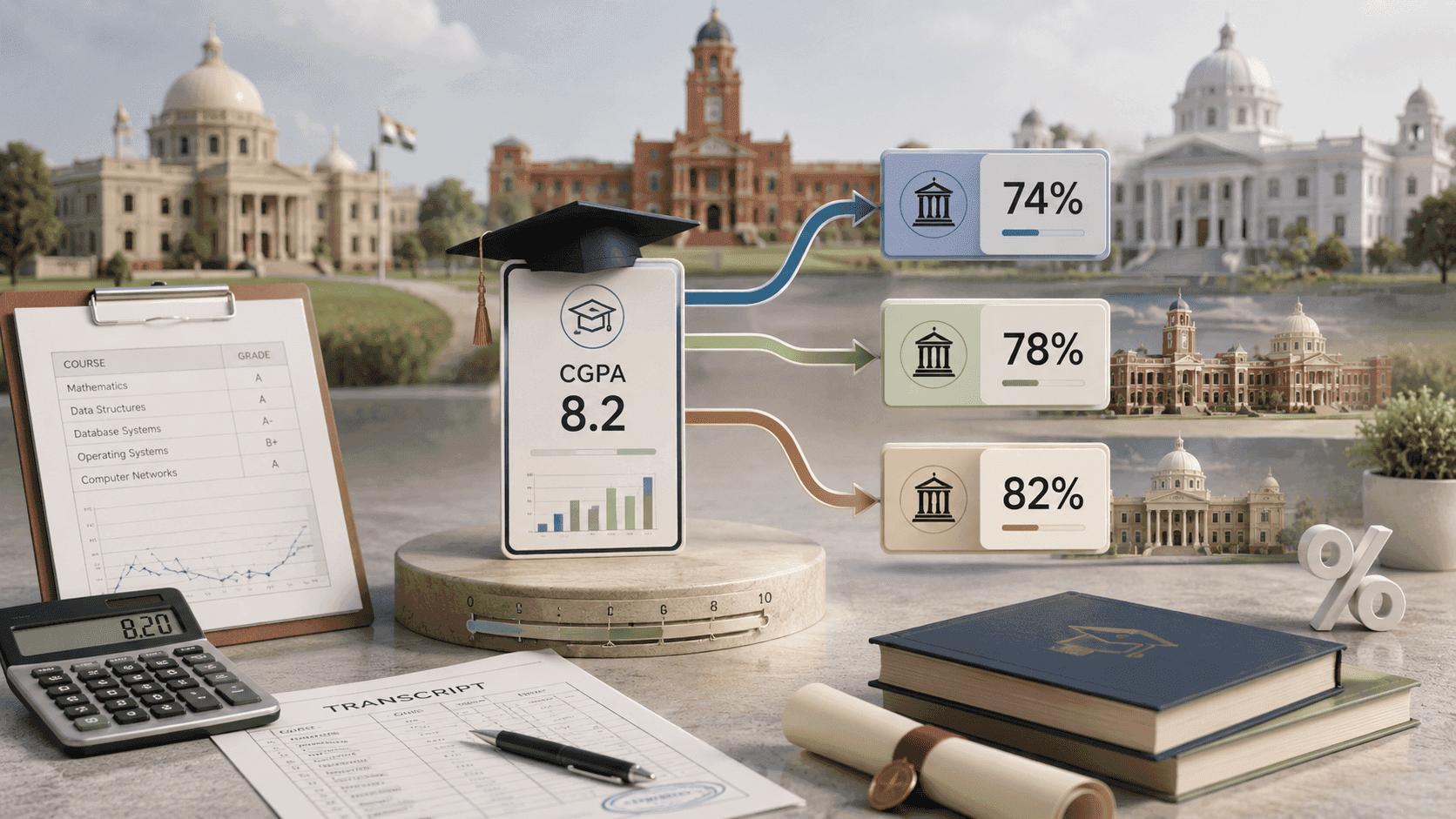
A CGPA of 8.20 does not have one official percentage equivalent across Indian universities. Under the university regulations examined for this comparison, the same numerical 8.20 can produce 67.00%, 70.45%, 74.50%, 77.90% or 82.00%, depending on the institution, programme, regulation and conversion method being applied.
This is not a disagreement between calculators. It follows from the way Indian higher education regulation works. The UGC's 2025 Minimum Standards regulations require higher education institutions using grades to work out and adopt a method for converting grades into percentages and vice versa. They do not prescribe one national rule such as CGPA × 10 or CGPA × 9.5 for every university. Evaluation components and their weightage also remain matters for the university's appropriate academic body.
To see how large the difference can be, this article compares official rules from 13 universities, plus one additional university admission rule that explicitly relies on the applicant's previous institution for conversion. Each formula below is tied to the programme, scheme or regulation actually supported by the cited university document. A formula listed for one programme should not be assumed to cover every student of that university.
The 8.20 CGPA test: how different can the result be?
First, consider only examples where the cited regulation uses a 10-point cumulative scale and where a CGPA or CGPI of 8.20 can therefore be inserted directly into the formula.
University and applicable rule | Official conversion method | 8.20 converts to |
|---|---|---|
Savitribai Phule Pune University, cited 2021 Credit and Semester System rules | For CGPA 7.50 to 8.49: Percentage = 10 × CGPA − 15 | 67.00% |
University of Mumbai, 10-point CBCS, Graduate and Post Graduate Choice Based courses from 2016-17 | Percentage = 7.25 × CGPI + 11 | 70.45%, with the circular permitting rounding to the next full integer, which gives 71% |
Visvesvaraya Technological University, 2015, 2017 and 2018 schemes only | Percentage = (CGPA − 0.75) × 10 | 74.50% |
Goa University, OA-16.4.8 | Percentage = (CGPA − 0.75) × 10 | 74.50% |
University of Delhi, MCA programme approved in 2022 | Final percentage = Grand CGPA × 9.5 | 77.90% |
Jamia Millia Islamia, cited M. Tech. regulation | Percentage = 10 × CGPA | 82.00% |
University of Kashmir, undergraduate programmes under NEP 2020 statutes | Percentage = CGPA × 10 | 82.00% |
University of Calicut, B. Tech. Regulations 2019 as modified in 2023 | Percentage marks = CGPA × 10 | 82.00% |
Anna University, M. Sc. 5-year Integrated Academic Regulations 2019 | Percentage of Marks = CGPA × 10 | 82.00% |
Pondicherry University, CBCS Guidelines for UG Courses | Percentage = CGPA × 10 | 82.00% |
Tezpur University, Regulations 2019 for UG and PG programmes | Equivalent percentage of marks = 10 × CGPA | 82.00% |
The difference between the lowest and highest result in this 8.20 comparison is 15 percentage points. A student applying SPPU's cited band-specific formula obtains 67.00%, while a student governed by one of the cited ×10 regulations obtains 82.00%.
That alone is enough to show why "8.2 CGPA equals 82%" cannot be treated as a national conversion rule.
Source-based comparison of 13 university conversion systems
University | Official document or regulation | Applicable scope in the source | Official conversion | Worked example |
|---|---|---|---|---|
University of Mumbai | Examinations Section Circular dated 17 October 2018, approved by Board of Examinations and Evaluation on 4 September 2018, Item No. 19 | Graduate and Post Graduate Choice Based courses commenced from academic year 2016-17. Formula specifically given for the 10-point CBCS system. | Percentage = 7.25 × CGPI + 11 | CGPI 8.20: 7.25 × 8.20 + 11 = 70.45%. The circular permits rounding to the next full integer. |
Savitribai Phule Pune University | Rules and Regulations for Credit and Semester System, updated 5 March 2021 | The Credit and Semester System covered by the cited SPPU document. The formula changes according to the CGPA grade band. | For CGPA 7.50 to 8.49: Percentage = 10 × CGPA − 15. Other CGPA bands use different equations. | CGPA 8.20: 10 × 8.20 − 15 = 67.00%. |
Visvesvaraya Technological University | VTU "CGPA Standard Formula" notice, posted 16 July 2022 | VTU expressly identifies the rule as applicable to the 2015, 2017 and 2018 schemes only. | Percentage = (CGPA − 0.75) × 10 | CGPA 8.20: (8.20 − 0.75) × 10 = 74.50%. |
Goa University | Ordinances, Part A, OA-16.4.8 | General University examination ordinance. The conversion provision is marked effective from 11 March 2021. | Percentage = (CGPA − 0.75) × 10 | CGPA 8.20: (8.20 − 0.75) × 10 = 74.50%. |
University of Delhi | MCA syllabus and examination provisions, A.C. 22.11.2022, Annexure 4.02.18 | MCA programme. The provision refers specifically to Grand CGPA based on all four semesters. | Final percentage of marks = Grand CGPA × 9.5 | CGPA 8.20: 8.20 × 9.5 = 77.90%. |
Jamia Millia Islamia | University Ordinances, M. Tech. examination provisions, clause 5.5 | Conversion after the Final Year M. Tech. Examination. | Y% = 10 × CGPA | CGPA 8.20: 10 × 8.20 = 82.00%. |
Mahatma Gandhi University, Kerala | University Order No. 6730/AC A9/2021/MGU dated 6 December 2021 | PG CSS 2019 regulations for postgraduate programmes in affiliated colleges covered by the order. The maximum grade point is 5. | Percentage = CGPA × 20 | CGPA 4.10 out of 5: 4.10 × 20 = 82.00%. |
University of Kerala | Revised Ph.D. Course Work Examination guidelines recorded in University proceedings | Ph.D. Course Work Examination, applicable from January 2021 registration under the cited decision. The grading structure uses grade points up to 6. | Percentage = Xi + CGPA fraction × A, where Xi is the lower percentage limit associated with the grade point and A is the difference between successive limits. | The university's own example converts CGPA 4.80 to 87.99%. |
University of Kashmir | Statutes for Undergraduate Programmes under NEP 2020, Annexure I to Notification dated 4 August 2023 | Undergraduate programmes governed by the cited NEP 2020 statutes. | Equivalent percentage = CGPA × 10 | CGPA 8.20: 8.20 × 10 = 82.00%. The statutes themselves illustrate 6.54 CGPA as 65.4%. |
University of Calicut | U.O. No. 13085/2023/Admn dated 19 August 2023 | B. Tech. Regulations 2019, applicable from 2019 admission onwards, with Clause 12 modified by the 2023 order. | Percentage marks = CGPA × 10 | CGPA 8.20: 8.20 × 10 = 82.00%. |
Anna University | Academic Regulations 2019 for M. Sc. 5-year Integrated Programme | The cited M. Sc. 5-year Integrated programme regulations. | Percentage of Marks = CGPA × 10 | CGPA 8.20: 8.20 × 10 = 82.00%. |
Pondicherry University | CBCS Guidelines for UG Courses, Section 17.3 | CBCS undergraduate guidelines. The document includes a B.A., B. Sc., B. Com and BBA programme template to be implemented from 2017-18 onwards. | Percentage = CGPA × 10 | CGPA 8.20: 8.20 × 10 = 82.00%. The official guideline itself gives 6.73 × 10 = 67.3%. |
Tezpur University | Regulations 2019, UG and PG | UG and PG programmes governed by the University's 2019 regulations. | Equivalent percentage of marks = 10 × CGPA | CGPA 8.20: 10 × 8.20 = 82.00%. |
1. University of Mumbai: CGPI is not simply multiplied by 10
The University of Mumbai provides one of the clearest official warnings against treating a cumulative grade index as if it were raw percentage marks.
Its Examination Section circular dated 17 October 2018 states that the cumulative Grade Point Index, or CGPI, is calculated using a weighted-average method and cannot be directly related scientifically to the actual percentage of marks. The university therefore describes its conversion as an approximate representation.
For the 10-point CBCS system covered by that circular:
Percentage = 7.25 × CGPI + 11
For CGPI 8.20:
7.25 × 8.20 + 11 = 70.45%
The circular further states that the calculated percentage can be rounded to the next full integer, so 70.45 becomes 71 where that instruction is applied.
The same circular treats the older 7-point CBGS differently. For that system, the percentage is based on the actual marks obtained by the candidate rather than applying the 10-point CBCS equation. This is an important example of a university having different conversion treatment for different grading structures.
2. SPPU: the formula can change when the CGPA changes
Savitribai Phule Pune University's cited Credit and Semester System rules demonstrate a different type of conversion. The formula is piecewise, which means a different equation is used for different CGPA ranges.
CGPA band | Formula in the cited SPPU rules |
|---|---|
9.00 to 10.00 | Percentage = 20 × CGPA − 100 |
8.50 to 8.99 | Percentage = 20 × CGPA − 100 |
7.50 to 8.49 | Percentage = 10 × CGPA − 15 |
6.50 to 7.49 | Percentage = 5 × CGPA + 22.5 |
5.50 to 6.49 | Percentage = 5 × CGPA + 22.5 |
4.25 to 5.49 | Percentage = 4 × CGPA + 28 |
4.00 to 4.24 | Percentage = 20 × CGPA − 40 |
For CGPA 8.20, the applicable band is 7.50 to 8.49:
10 × 8.20 − 15 = 67.00%
This is a particularly useful warning for calculator design. A calculator cannot use one SPPU multiplier across the complete grading scale if the applicable university regulation is itself band-dependent. It must first determine which CGPA interval contains the student's value and then apply the correct equation for that interval.
3. VTU: subtract 0.75 before multiplying by 10
Visvesvaraya Technological University's official website published a "CGPA Standard Formula" notice on 16 July 2022. The university explicitly labels it for the 2015, 2017 and 2018 schemes only:
Percentage = (CGPA − 0.75) × 10
For CGPA 8.20:
(8.20 − 0.75) × 10 = 74.50%
A generic ×10 conversion would instead produce 82%. In this example that would overstate the official VTU result by 7.50 percentage points.
The scheme limitation matters just as much as the formula. The VTU notice does not say that the equation automatically applies to every scheme ever introduced by the university. A student should therefore identify the applicable scheme before using it.
4. Goa University: the same equation as VTU, but from a separate university ordinance
Goa University's current Part A ordinance compilation contains its own formal conversion rule in OA-16.4.8. The provision, marked effective from 11 March 2021, states:
Percentage = (CGPA − 0.75) × 10
For CGPA 8.20:
(8.20 − 0.75) × 10 = 74.50%
The ordinance also gives the reverse relationship:
CGPA = (Percentage ÷ 10) + 0.75
The fact that Goa University and VTU use the same mathematical expression in the cited rules does not make it a national formula. Each formula has authority because the respective institution has formally adopted it for the stated academic framework.
5. University of Delhi: ×9.5 exists, but scope is critical
The common claim that "Indian universities use CGPA × 9.5" also fails when treated as a universal rule.
An official University of Delhi MCA document approved by the Academic Council on 22 November 2022 states:
Final percentage of marks = CGPA based on all four semesters × 9.5
For an MCA Grand CGPA of 8.20:
8.20 × 9.5 = 77.90%
The crucial wording here is the scope. The primary document examined is for the MCA programme. It should not be rewritten as "Delhi University uses ×9.5 for every course and every batch" unless a separate university-wide rule establishes that broader application.
This is exactly why a useful university calculator should store the source, programme and regulation context together with the mathematical expression.
6. Jamia Millia Islamia: ×10 in one programme does not prove one formula for the entire university
Jamia Millia Islamia's University Ordinances provide a useful example of programme-specific regulation.
For conversion after the Final Year M. Tech. Examination, clause 5.5 states that CGPA is multiplied by a factor of 10:
Y% = 10 × CGPA
Thus:
8.20 × 10 = 82.00%
The same ordinance compilation also contains a ×10 conversion for undergraduate qualifications covered by its newer undergraduate framework.
Yet an official Jamia M.Phil regulation has used a different expression:
Percentage of Marks = (CGPA − 0.5) × 10
If 8.20 were inserted into that M.Phil equation:
(8.20 − 0.50) × 10 = 77.00%
The M. Tech. and M.Phil examples should not be merged into a single "JMI formula." They demonstrate the opposite: even within one university, programme regulations can produce different conversion methods.
7. Mahatma Gandhi University: a 5-point CGPA scale changes the arithmetic completely
Mahatma Gandhi University in Kerala provides one of the strongest reasons not to assume that every CGPA is measured out of 10.
University Order No. 6730/AC A9/2021/MGU dated 6 December 2021 establishes a conversion for postgraduate programmes governed by the PG CSS 2019 regulations covered by the order. It specifically states that the maximum grade point is 5.
The rule is:
Percentage = CGPA × 20
For CGPA 4.10 out of 5:
4.10 × 20 = 82.00%
The order also requires the percentage to be rounded to two decimal places.
Multiplying 4.10 by 10 would give 41%, which would bear no resemblance to the official result under this regulation. The problem is not just choosing the wrong multiplier. It is failing to identify the scale on which the CGPA was awarded.
8. University of Kerala: conversion can be an interpolation, not a multiplication
The University of Kerala's revised Ph.D. Course Work Examination rules provide an even more instructive example. The cited rules use a grade-point structure with values up to 6 and calculate equivalent percentage using the location of the CGPA inside a grade interval.
The published expression is:
Percentage of Marks = Xi + CGPA fraction × A
Here, Xi represents the marks at the lower limit of the relevant grade point and A represents the difference in marks between the two successive grade points.
The University's own examples include:
CGPA 5.90 = 98.99%
CGPA 4.80 = 87.99%
CGPA 1.10 = 55.49%
CGPA 3.00 = 69.99%
For CGPA 4.80, the official calculation shown is:
79.99 + 0.8 × (89.99 − 79.99) = 87.99%
A generic linear multiplier cannot reproduce this system correctly. The calculator must first identify the grade interval and then apply the university's interpolation rule.
9. University of Kashmir: an explicit ×10 rule under the cited NEP statutes
The University of Kashmir's statutes for undergraduate programmes under NEP 2020 state the conversion directly:
Equivalent percentage = CGPA × 10
The document provides its own example, stating that a CGPA of 6.54 out of 10 is equivalent to 65.4 out of 100.
For CGPA 8.20:
8.20 × 10 = 82.00%
This is an official ×10 example. It is evidence that ×10 is correct for the scope of these Kashmir University statutes. It is not evidence that ×10 is correct for Mumbai University, VTU, Goa University, SPPU or another institution.
10. University of Calicut: the B. Tech formula was formally changed
The University of Calicut example shows why the date of the regulation matters in addition to the university name.
University Order No. 13085/2023/Admn dated 19 August 2023 modifies Clause 12 of the B. Tech Regulations 2019, applicable from 2019 admission onwards, and changes the CGPA-to-percentage formula to:
Percentage marks = CGPA × 10
For CGPA 8.20:
8.20 × 10 = 82.00%
The order explicitly records that the B. Tech regulation was being modified. That makes it unsafe to take a formula from an older Calicut document and apply it automatically after the amendment, or to take this B. Tech rule and assume that every other Calicut University programme uses the same method.
11. Anna University: ×10 under the cited 5-year Integrated M. Sc. regulations
Anna University's Academic Regulations 2019 for the M. Sc. 5-year Integrated programme state that the CGPA shown in the consolidated grade sheet is converted as:
Percentage of Marks = CGPA × 10
For CGPA 8.20:
8.20 × 10 = 82.00%
The source is programme-specific. The academically safe statement is therefore that the cited M. Sc. 5-year Integrated regulation uses ×10, rather than converting that finding into an unsupported rule for every Anna University programme and regulation year.
12. Pondicherry University: the official CBCS UG guideline includes its own worked example
Pondicherry University's CBCS Guidelines for UG Courses are particularly useful because the document explains the conversion and provides a numerical example.
Section 17.3 states:
Percentage = CGPA × 10
The university illustrates the rule using CGPA 6.73:
6.73 × 10 = 67.3%
The same document contains the CBCS template for B.A., B. Sc., B. Com and BBA programmes to be implemented from 2017-18 onwards.
Using the same rule for CGPA 8.20 gives:
8.20 × 10 = 82.00%
13. Tezpur University: the 2019 UG and PG regulations define the conversion directly
Tezpur University's Regulations 2019 for UG and PG programmes calculate CGPA on a 10-point scale and then give a separate equation for its equivalent percentage:
Equivalent percentage of marks = 10 × CGPA
For CGPA 8.20:
10 × 8.20 = 82.00%
This is another legitimate ×10 system, but its legitimacy comes from Tezpur University's published regulation. The formula is not valid merely because 10 is also the maximum CGPA.
A different approach: when the receiving university uses your original university's conversion
Not every academic process needs the receiving university to invent a new CGPA-to-percentage formula.
Sant Gadge Baba Amravati University's postgraduate prospectus provides a useful example for applicants whose previous institution awarded grades or CGPA instead of marks. Its admission instruction states that conversion into percentage is to be based on the procedure certified by the university or institution from which the candidate obtained the bachelor's degree.
This is not an SGBAU formula for converting the CGPA of its own graduates. It is an admission treatment of an external applicant's result. The distinction is important.
If a candidate arrives with an 8.20 CGPA from University A, the receiving institution may need the conversion procedure officially certified by University A. It would be wrong to substitute a convenient generic formula simply because the application form asks for a percentage.
The same university can change its formula by programme, scheme or regulation year
The comparison becomes more useful when it is read vertically, not just horizontally.
University-level labels alone are sometimes too broad. Jamia Millia Islamia provides one example, with ×10 in the cited M. Tech. regulations but a different (CGPA − 0.5) × 10 expression in the cited M.Phil rule. University of Mumbai separates its treatment of the 7-point CBGS system from its 10-point CBCS system. The University of Calicut's 2023 order formally modified the formula contained in its B. Tech Regulations 2019. VTU's own notice says that its (CGPA − 0.75) × 10 standard formula is for the 2015, 2017 and 2018 schemes only.
A database that stores only:
University name → Formula
is therefore not detailed enough for many institutions.
A more reliable structure is:
University → Faculty or programme → Regulation or scheme → Admission batch → Grade scale → Conversion formula → Rounding rule → Primary source
That structure prevents an older or programme-specific formula from being silently presented to a student governed by a different regulation.
Four fundamentally different conversion models appear in the primary sources
The university documents examined here are not merely variations of one multiplication factor. They represent several different mathematical models.
Conversion model | Examples from this research | What happens at the same CGPA |
|---|---|---|
Direct multiplier | CGPA × 10 at Kashmir, Calicut B. Tech., Pondicherry CBCS UG, Tezpur UG/PG and the cited JMI M. Tech. rule | 8.20 becomes 82.00% |
Different direct multiplier | Grand CGPA × 9.5 in the cited University of Delhi MCA programme | 8.20 becomes 77.90% |
Linear formula with an offset | 7.25 × CGPI + 11 at Mumbai; (CGPA − 0.75) × 10 at VTU and Goa | 8.20 becomes 70.45% at Mumbai and 74.50% at VTU or Goa |
Grade-band formula | SPPU cited Credit and Semester System rules | The equation itself changes according to the student's CGPA band |
Different maximum CGPA scale | Mahatma Gandhi University PG CSS 2019 uses maximum grade point 5 and CGPA × 20 | 4.10 out of 5 becomes 82.00% |
Interval interpolation | University of Kerala Ph.D. Course Work rules | 4.80 on its 6-point structure becomes 87.99% in the University's example |
The mathematical differences reflect different grading structures. A CGPA is produced after marks have already been translated into grade points and weighted by credits. It is not simply a percentage with its decimal point moved.
Why a CGPA of 8.20 does not preserve the student's original marks
Suppose two students receive the same final CGPA of 8.20. That does not prove that both students obtained exactly 82% of all possible raw marks.
A grade-point system can first place marks into bands. Different marks inside the same band may receive the same grade point. Course credits then determine how much weight each grade point receives in SGPA and CGPA. By the time the cumulative CGPA is calculated, some of the detail contained in the original raw marks has been compressed into a grade-based measure.
The University of Mumbai makes this limitation unusually explicit. Its 2018 circular says that CGPI is calculated through a weighted-average method that cannot be directly related scientifically to the actual percentage of marks and calls its percentage formula an approximate representation.
This explains why conversion formulas can legitimately contain offsets, different slopes, piecewise equations or interpolation instead of simply multiplying by 10.
Why ×10 works perfectly at some universities and fails badly at others
Take CGPA 8.20 and compare the official calculations represented in this dataset:
Method | Calculation | Percentage | Difference from blindly using ×10 |
|---|---|---|---|
Direct ×10 | 8.20 × 10 | 82.00% | 0 |
DU MCA ×9.5 | 8.20 × 9.5 | 77.90% | ×10 would be 4.10 points too high |
VTU and Goa offset rule | (8.20 − 0.75) × 10 | 74.50% | ×10 would be 7.50 points too high |
Mumbai CBCS formula | 7.25 × 8.20 + 11 | 70.45% | ×10 would be 11.55 points too high before the circular's whole-integer rounding instruction |
SPPU cited 7.50 to 8.49 band | 10 × 8.20 − 15 | 67.00% | ×10 would be 15.00 points too high |
In other words, a single generic ×10 calculator could be exactly right for one student and substantially wrong for another, even when both enter the same CGPA.
Why UGC does not give every Indian university one CGPA formula
The current UGC regulatory language helps explain the variation.
Under the UGC Minimum Standards of Instruction for the Grant of Undergraduate Degree and Postgraduate Degree Regulations, 2025, the relevant academic body of the university determines evaluation units and their weightage. The regulations then require HEIs to work out and adopt a table for conversion of grades into percentages and vice versa.
The wording is significant. UGC requires an institutional conversion mechanism. It does not follow that UGC itself supplies one universal equation.
This distinction should also prevent a common attribution error. A university may use CGPA × 10 while operating within the broader UGC framework, but that does not make ×10 "the UGC formula." Unless a UGC regulation itself specifies that equation for the situation being discussed, the correct attribution is to the university regulation that actually establishes it.
How to determine which CGPA-to-percentage formula applies to you
Identify the university that awarded the CGPA. Do not start with a generic online formula.
Check the programme. B. Tech., MCA, M. Tech., undergraduate CBCS, postgraduate CSS and Ph.D. coursework can have different rules even within the same institution.
Check your admission year or academic scheme. A formula published for a 2018 scheme may not govern a 2022 or 2025 scheme.
Confirm the CGPA scale. A CGPA out of 5, 6 or 10 cannot be processed as though the scales were identical.
Read the exact conversion clause. Look for "CGPA to percentage," "conversion of grades," "equivalent percentage," "Grand CGPA into marks" or similar wording in the university's regulations or ordinances.
Check rounding separately. Do not round merely because another university does. Mumbai's cited circular has an explicit next-full-integer instruction, while MGU's cited order specifies two decimal places.
Check whether the formula produces an equivalent percentage rather than actual aggregate marks. These are not always conceptually the same thing.
For admissions to another university, follow the receiving institution's instructions. It may ask for a conversion certificate or require the method prescribed by the institution that awarded the CGPA.
Why students should never blindly multiply CGPA by 10
CGPA × 10 is an official formula at several Indian universities, but it is not an automatic Indian university formula.
It works for the University of Kashmir students covered by the cited NEP undergraduate statutes, the University of Calicut B. Tech students covered by the modified 2019 regulations, Pondicherry University students covered by the cited CBCS UG guidelines, Tezpur students covered by the 2019 UG and PG regulations, and other programmes whose official regulations explicitly prescribe ×10.
But an 8.20 CGPA under the University of Delhi MCA rule converts to 77.90%, not 82%. Under the cited VTU and Goa rules it converts to 74.50%. Under Mumbai's cited CBCS formula it calculates to 70.45% before the circular's specified whole-integer rounding treatment. Under the cited SPPU grade band it becomes 67.00%.
There is an even more basic problem with the assumption: not every CGPA is out of 10. Mahatma Gandhi University's cited PG CSS 2019 conversion works from a maximum grade point of 5 and multiplies CGPA by 20. The University of Kerala Ph.D. coursework example uses a 6-point structure and an interval-based conversion equation.
The correct first question is therefore not "What number should I multiply my CGPA by?" It is "Which official regulation applies to my university, programme and batch?"
Once that source is known, the calculation is usually straightforward. Without it, even perfectly executed arithmetic can produce the wrong percentage.