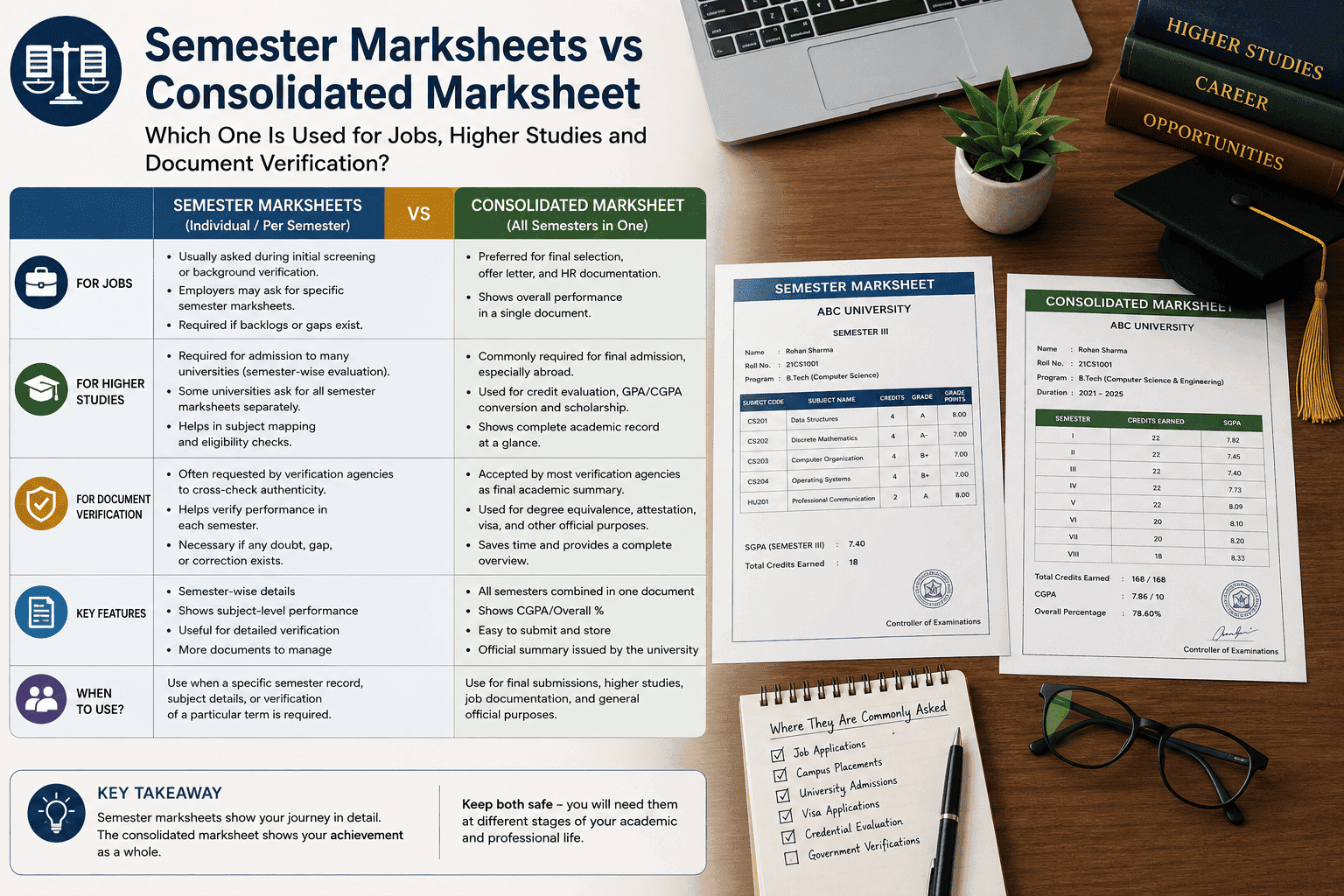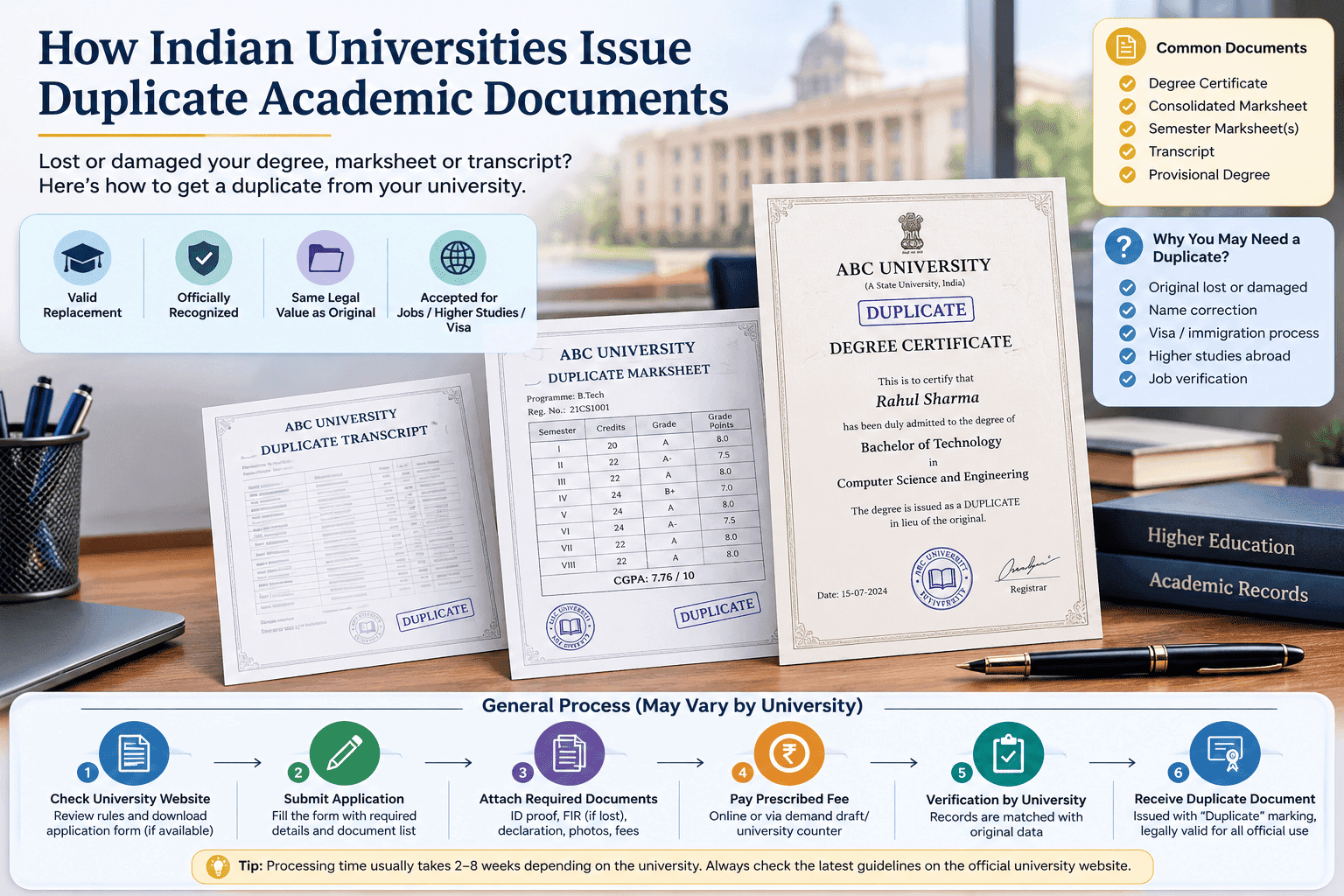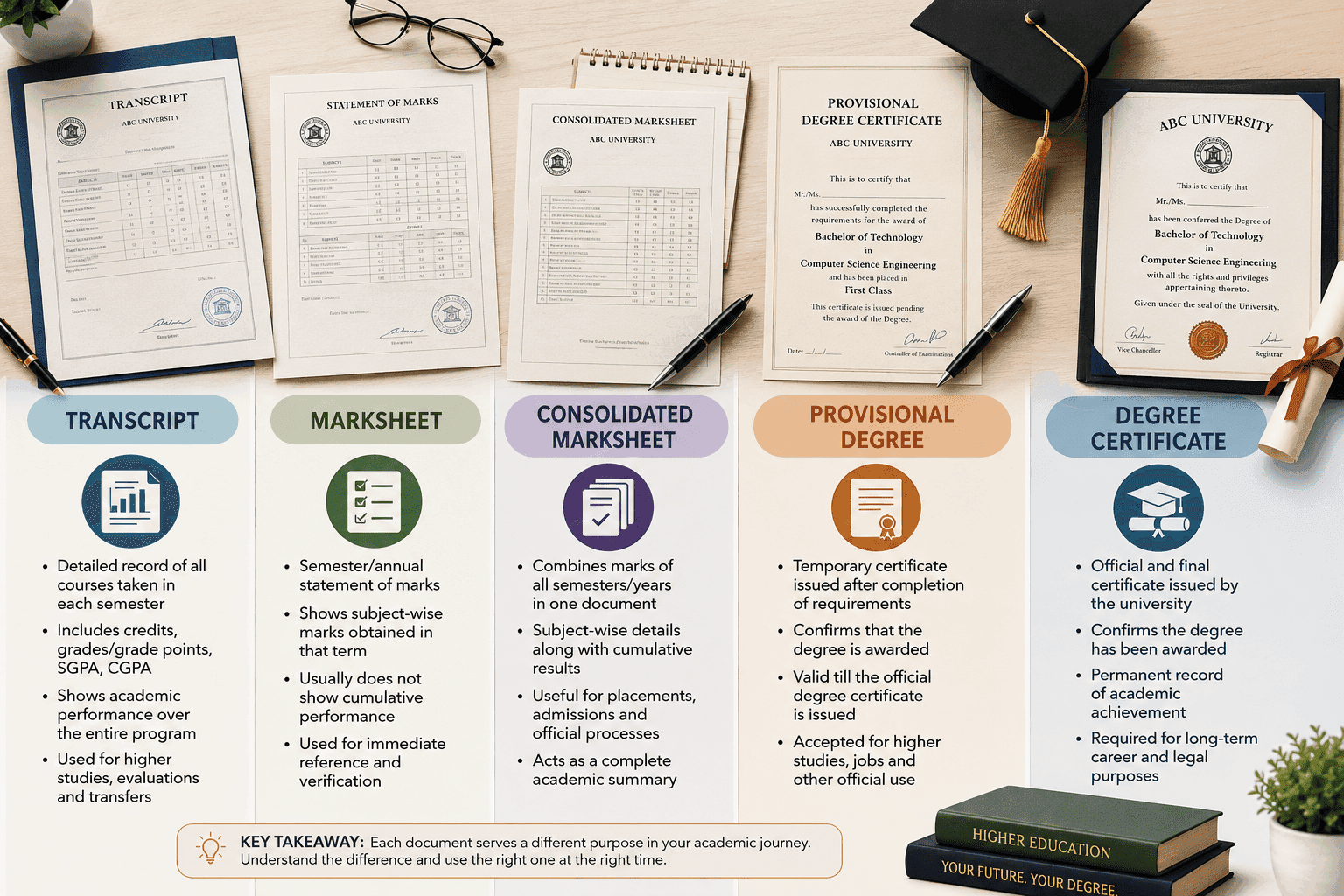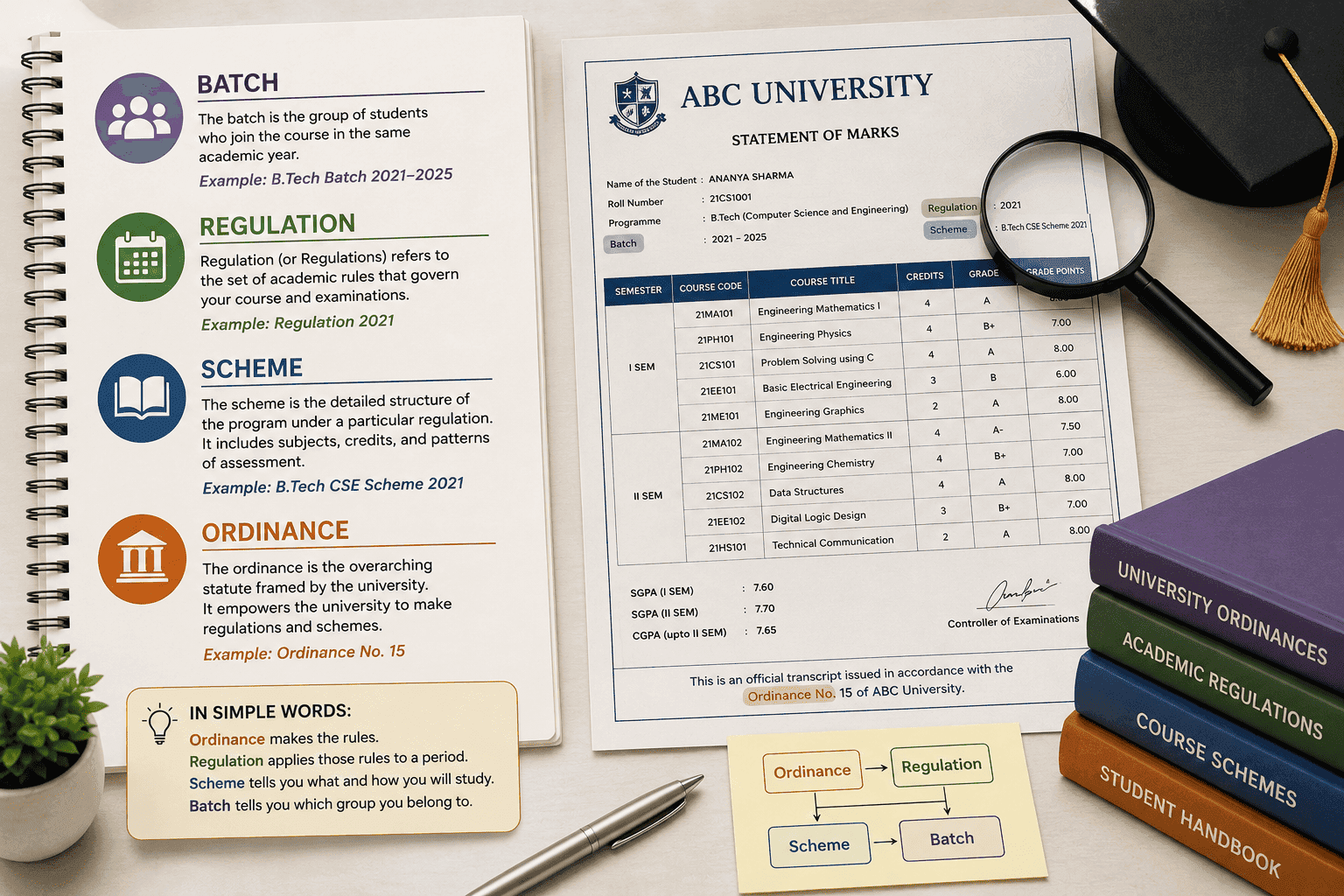
A university name and course name are often not enough to identify the academic rules that apply to a student. Two students can complete the same B. Tech., B. Com. or B. Sc. at the same university but follow different credit structures, passing requirements, grading tables, CGPA calculations or percentage-conversion rules because they entered under different batches, regulations or schemes.
This is why marksheets and university documents contain labels such as 2019 Regulation, 2022 Scheme, CBCS, UGCF-2022, NEP-2020, Academic Session 2022-23, Ordinance OA-16 or a numbered university direction. These labels are not administrative decoration. They can identify the rulebook under which the student's result was produced.
There is also no safe all-India hierarchy in which every university uses the words "regulation", "scheme", "ordinance" and "direction" in exactly the same legal way. Universities operate under different Acts, statutes and academic structures. The practical task for a student is therefore to identify the exact document, commencement clause, programme and admission cohort that govern the result.
Start with the marksheet, not the formula
Suppose a fictional engineering marksheet contains this information:
Illustrative University Examination Grade Card | |||
|---|---|---|---|
Programme | B.E. Computer Science | Semester | VI |
Admission Year | 2022 | Academic Year | 2024-25 |
Scheme | 2022 Scheme | Examination | May/June 2025 |
SGPA | 8.14 | CGPA | 8.20 |
If this student searches only for "university CGPA to percentage formula", an older official page may appear in the results. The calculation on that page might even look convincing.
But the student should first ask:
Does that formula apply to the 2022 Scheme?
Visvesvaraya Technological University provides a real example of why this check matters. VTU's official CGPA Standard Formula page states:
Percentage = (CGPA - 0.75) × 10
Crucially, the same page says that this standard formula is for the 2015, 2017 and 2018 schemes only.
For CGPA 8.20, the arithmetic would be:
(8.20 - 0.75) × 10 = 74.50%
The arithmetic is correct. But if the student's marksheet says 2022 Scheme, the cited VTU page itself does not establish that 74.50% is the student's official conversion.
This is the central rule for interpreting university regulations: a mathematically correct calculation can still be academically wrong if it comes from the wrong scheme.
The seven labels that help identify your actual academic rule
Term | What it usually identifies | Why it matters |
|---|---|---|
Batch | A cohort of students, commonly identified by admission or entry year | Different batches can remain under different rules even while studying at the university at the same time. |
Regulation | A formally adopted set of academic rules governing a programme or group of programmes | Can determine credits, examinations, passing, grading, promotion, CGPA and classification. |
Scheme | A particular curriculum and examination structure, often identified by a year | A formula or passing rule may be valid for one scheme and not another. |
Ordinance | A university rule made under the institution's statutory framework | May govern examinations, grading, award of class, programmes or other academic matters. |
Direction | A formal direction issued by a university under the powers available to it | At some universities, programme examination rules are introduced or implemented through numbered Directions. |
Academic session | The academic period from which a rule, curriculum or amendment operates | A new rule can begin from 2026-27 without automatically rewriting earlier academic records. |
Syllabus revision | A revision to course content, papers, credit distribution or curriculum structure | A new syllabus does not automatically mean every examination rule has changed, but the revision notice may modify credits or assessment. |
“Batch” usually answers: when did you enter the programme?
In everyday university usage, a batch normally refers to a cohort of students associated with an admission year or academic session. A "2022 batch" may therefore mean students admitted in 2022 or in academic session 2022-23.
This matters because universities frequently preserve the rules applicable to an existing cohort while introducing a new structure for later admissions.
The University of Calicut's official regulations repository makes this particularly easy to see. It separately catalogues regulations by admission year, including CBCSS UG Regulations for 2019 admissions, CCSS PG Regulations 2022 for 2022 admissions, B. Tech. regulations connected to 2019 admissions and modified B. Tech. regulations effective from 2024 admissions.
That means the question:
"What are the University of Calicut B. Tech. rules?"
can be incomplete.
A better question is:
"Which University of Calicut B. Tech. regulation applies to my admission year?"
Batch is not necessarily your graduation year
A student admitted to a four-year programme in 2022 might graduate in 2026. That does not normally make the student a "2026 admission batch". For academic-rule identification, the entry year is often much more important than the year printed on the final examination result.
A student might therefore have:
Admission | 2022-23 |
Final examination | 2026 |
Convocation | 2027 |
Applicable regulation | Potentially the regulation made applicable to 2022 admissions |
Searching by graduation year alone can lead the student to a regulation meant for a later cohort.
“Regulation year” identifies a rulebook, not automatically the year you studied
When a marksheet, syllabus or university PDF says Regulations 2019, the year generally identifies that regulation or regulatory framework. It does not necessarily mean that every student who happened to study during 2019 follows it.
The important wording is usually found in the application or commencement clause:
"with effect from 2019 admissions"
"applicable to students admitted from..."
"w.e.f. academic session..."
"shall apply to..."
"from the date of notification"
University of Calicut provides a useful primary-source example. Its B. Tech. regulatory order states that the B. Tech. regulations were implemented with effect from 2019 admission onwards. A 2023 university order then modified the CGPA-to-percentage formula in Clause 12 of that same 2019 regulation.
This creates an important distinction:
Date or year | What it represents in this example |
|---|---|
2019 | Admission cohort from which the B. Tech. regulation applies |
2021 | A later university order corrected parts of the regulation while retaining its application to 2019 admissions onwards |
2023 | A later order modified the CGPA conversion provision |
The 2023 document did not become a "2023 batch regulation" merely because it was issued in 2023. It expressly modified the regulation governing the specified earlier admission cohort.
Publication date, regulation year and effective date are three different things
This distinction prevents many errors when researching an old marksheet.
Consider a university order uploaded in 2023:
Document date: 19 August 2023
That does not tell you by itself who is covered.
Inside the document it may say:
B. Tech. Regulations 2019, applicable from 2019 admission onwards.
In that situation:
2019 identifies the underlying regulation or admission framework;
2023 identifies the date of the later order;
the text of the order establishes whether and how it modifies the 2019 cohort.
Never choose a regulation simply because its PDF has the same year as your marksheet.
“Scheme” usually means a particular curriculum and examination structure
The term scheme is especially common in engineering and technical universities. A scheme can package together the curriculum, course credits, examination structure, assessment method, progression rules and other programme requirements for a defined set of students.
A scheme is often labelled by a year:
2015 Scheme
2017 Scheme
2018 Scheme
2022 Scheme
The year is therefore a key lookup field.
VTU's official website currently maintains programme material under multiple B.E./B. Tech. structures, including 2015-16, 2017-18, 2018-19 and 2022 programme material. Its CGPA formula page then deliberately limits the (CGPA - 0.75) × 10 formula to the 2015, 2017 and 2018 schemes.
That is exactly the sort of limitation an online calculator must preserve.
A scheme number is not necessarily a marksheet year
A final-year student taking an examination in 2026 could still belong to an older scheme because the scheme follows the student's cohort through the programme.
So:
Examination held in 2026 ≠ automatically 2026 Scheme
The scheme printed on the marksheet, registration record or applicable academic document is the stronger clue.
CBCS is a system label, not one national grading table
CBCS stands for Choice Based Credit System. It identifies a credit-based academic approach in which students study courses carrying specified credits and normally have some structured choice among course categories.
But "CBCS" alone is not enough to identify a grading rule.
Universities have introduced CBCS at different times and with different grading scales, curriculum structures and conversion methods.
The University of Mumbai provides a useful example. Its 2018 examination circular deals with Graduate and Post Graduate Choice Based courses commenced from academic year 2016-17. It distinguishes an older 7-point CBGS treatment from the 10-point CBCS system, for which the university prescribed:
Percentage = 7.25 × CGPI + 11
The circular also states that the calculated percentage can be rounded to the next full integer.
A student who sees "CBCS" on another university's marksheet cannot borrow Mumbai University's formula. CBCS describes the academic system, while the actual grade and conversion rules come from the applicable university regulation.
NEP is another framework label, not a universal university scheme
A marksheet or curriculum may also refer to NEP 2020, FYUGP, UGCF or another institution-specific implementation of National Education Policy 2020.
These labels need to be read carefully.
NEP 2020 is the national policy. Universities then implement academic structures through their own approved frameworks, statutes, ordinances, regulations and syllabi.
The University of Kashmir provides a clear example. Its official Statutes Governing Undergraduate Programmes (UGP) 2022 state that the university designed its undergraduate curriculum framework in consonance with NEP 2020 from Academic Session 2022-23. The statutes provide for major, minor, multidisciplinary and other course categories together with multiple exit options.
Delhi University uses another institutional label: Undergraduate Curriculum Framework 2022, or UGCF-2022. DU states that UGCF-2022 was developed to implement NEP 2020 at the undergraduate level.
Both systems relate to NEP 2020, but a Kashmir University statute should not be used to calculate a Delhi University student's credits or grades.
“Ordinance” can contain the rule behind the number on your marksheet
An ordinance is a formal university rule adopted under the institution's statutory framework. Universities frequently organize enduring academic and examination rules into numbered ordinances.
The exact subject matter and legal procedure vary by university, so the word should not be treated as having one identical scope across India.
Goa University illustrates how academically important an ordinance can be. Its Ordinance OA-16 contains provisions for award of class and grade. OA-16.4 addresses the grade system, while OA-16.4.8 prescribes the conversion:
Percentage = (CGPA - 0.75) × 10
The ordinance labels that conversion provision effective from 11 March 2021.
The university's current ordinance compilation also explains that minimum passing standards may vary from programme to programme and that the respective ordinance governing each programme determines whether class or grade is awarded.
This shows why a reference such as OA-16.4.8 can be more useful than a general search for "Goa University CGPA formula". It points to the provision from which the rule originates.
“Direction” is not just informal advice
Some Indian universities issue formally numbered Directions dealing with examinations and academic programmes.
Sant Gadge Baba Amravati University's official Gazette Notifications page provides many examples. Its 2023 records include Direction No. 45 of 2023 for examinations leading to the Bachelor of Arts degree under the Choice Based Credit System, Direction No. 55 of 2023 for B. Com., Direction No. 56 for BBA and separate Directions for other programmes.
The same official archive includes an Extra Ordinary Direction No. 15 of 2023 dealing with examinations leading to the B.P.Ed. degree and Direction No. 16 of 2023 for M.P.Ed.
For a student, the lesson is practical. If an official university page says that a specific programme is governed by "Direction No. 45 of 2023", the relevant academic rule should be read from that Direction and any applicable amendments, rather than from an unrelated regulation found elsewhere on the university website.
Regulation, ordinance and direction should not be ranked from their names alone
It is tempting to create a simple hierarchy such as:
Ordinance > Regulation > Direction > Notification
That is not a safe universal method for Indian universities.
Different university Acts authorize academic rules in different ways. A document called a Direction at one state university may perform a function that another university handles through regulations or an ordinance. The title alone therefore does not establish its legal priority.
When two university documents appear to conflict, inspect:
which document applies to your programme;
which cohort or admission year it covers;
its commencement clause;
whether one document expressly amends or supersedes the other;
the date from which the amendment takes effect;
any university order or Academic Council decision implementing the change.
An explicit statement such as "the earlier regulation stands modified to this extent" is much stronger evidence than choosing whichever PDF has the later publication date.
Academic session tells you when something starts operating
An academic session is the university's academic period, commonly expressed as 2022-23, 2025-26 or 2026-27.
This can determine when a curriculum, credit change or examination provision begins to operate.
Delhi University's UGCF provides a current example. DU introduced UGCF-2022 as its NEP-aligned undergraduate framework. Its Academic Affairs office now also lists a notification dated 10 July 2026 increasing credits for the Research/Entrepreneurship track of fourth-year UGCF-2022 with effect from academic session 2026-27 onwards.
This illustrates why "UGCF-2022" should not be interpreted as meaning that the framework can never be amended after 2022. A framework can retain its original name while later notifications modify particular components from a stated session.
Why a 2022-admission student and a 2026-admission student can have different rules
Imagine two students at the same university:
Student A | Student B | |
|---|---|---|
Programme | Bachelor's programme | Same Bachelor's programme |
University | Same university | Same university |
Admission | 2022-23 | 2026-27 |
Framework at entry | 2022 regulation or scheme | Later regulation, revised scheme or amended framework |
Between those admission years, the university could have changed:
the number of credits assigned to a paper;
the total programme credits;
internal and external assessment weightage;
minimum pass marks;
the letter-grade table;
promotion or carry-forward rules;
multiple-entry or exit provisions;
CGPA calculation;
CGPA-to-percentage conversion;
classification such as First Class or Distinction;
course categories or compulsory papers.
The later rules do not necessarily rewrite Student A's academic history. Universities frequently use phrases such as "with effect from 2024 admissions" precisely to separate one cohort from another. Calicut University's regulation repository is a real example of this cohort-based organisation, listing different regulations against 2019, 2021, 2022, 2024 and 2025 admission years.
Syllabus revision is narrower than a regulation change, but it can still matter
A syllabus normally describes the academic content and structure of courses. A syllabus revision can change topics, papers, course codes, credit distribution or semester placement without necessarily replacing every examination regulation.
That distinction matters when a student finds two PDFs with slightly different paper names.
Delhi University's Department of Commerce, for example, maintains UGCF material containing semester-specific approved syllabi, revised syllabus material, a notification concerning revised credit distribution and an amendment to Ordinance V.
These are related documents, but they do not all perform the same function.
Document type | Question it may answer |
|---|---|
Syllabus | What papers and content do I study? |
Credit-distribution notification | How are credits allocated among course categories? |
Examination regulation | How am I assessed and what constitutes passing? |
Ordinance amendment | Which standing university rule has formally changed? |
A new syllabus should therefore not be used automatically as proof that the CGPA formula changed. Conversely, if the revision notification expressly changes a paper's credits, those revised credits can affect a credit-weighted SGPA calculation for the students to whom the change applies.
“Revised” does not tell you who the revision applies to
One of the riskiest filenames in university research is:
Revised Regulations.pdf
The word "revised" says that something changed. It does not identify the affected students.
You still need to find language such as:
"applicable from 2024 admission onwards";
"for students admitted under the 2022 Scheme";
"with effect from academic session 2026-27";
"applicable to Semester III from...";
"students registered prior to... shall continue under the old regulation".
The commencement and applicability language is usually more important than the filename.
Amendments can alter an old regulation without changing its name
This is another reason simple formula databases go wrong.
A university may have:
B. Tech Regulations 2019
and later issue:
Amendment 2021
Modification 2023
Corrigendum 2024
The student may still be governed by "Regulations 2019", but the version that should be applied is the original regulation read together with later amendments that cover the same cohort.
The University of Calicut example is especially clear. Its 2023 B. Tech order says that Clause 12 of the regulation applicable from 2019 admissions onwards was modified so that:
Percentage marks = CGPA × 10
It then states that the earlier University Order stands modified to that extent.
For a 2019-admission B. Tech. student, locating the original 2019 regulation but ignoring its later applicable modification could therefore produce an outdated conversion.
Worked investigation: which CGPA rule applies to this student?
Consider this fictional case.
University | Visvesvaraya Technological University |
Programme | B.E. |
Admission | 2022 |
Marksheet label | 2022 Scheme |
CGPA | 8.20 |
Online rule found | Percentage = (CGPA - 0.75) × 10 |
Step 1: verify that the source is actually official
The formula appears on VTU's official domain, so the source passes the first check.
Step 2: read the complete applicability statement
The page says the formula is for:
2015, 2017 and 2018 scheme only.
Step 3: compare that with the student's marksheet
The marksheet says:
2022 Scheme
There is no match.
Step 4: do not use the formula merely because the university name matches
If the student nevertheless calculates:
(8.20 - 0.75) × 10 = 74.50%
74.50% is the mathematical output of the older-scheme formula. The cited page does not establish it as the official conversion for this fictional 2022-Scheme student.
Step 5: locate the rule for the student's actual scheme
The next research target should be VTU's official regulation, notification or examination material for the 2022 Scheme. VTU's official website separately lists programme material for the 2022 B.E./B. Tech. scheme, reinforcing that it exists as a distinct academic structure.
Until a 2022-Scheme source establishes the applicable conversion, the academically correct answer is:
The older formula has been verified, but it should not be presented as the student's official formula because the university expressly limits it to earlier schemes.
A five-part identifier is safer than the university name
When researching an academic rule, try to establish this identifier:
1. University | Which institution awards the result? |
2. Programme | B. Tech., B.A., B. Com., MCA, M. Sc., etc. |
3. Admission year | When did the student enter the programme? |
4. Regulation or scheme | 2018 Scheme, Regulations 2019, UGCF-2022, NEP UGP 2022, etc. |
5. Amendments | Has the university subsequently modified the rule for that cohort? |
A sixth field is sometimes necessary:
Faculty or programme-specific regulation.
A university can use different examination regulations for Engineering, Law, Education or another professional programme. The University of Calcutta, for example, publishes a distinct Regulations and Syllabus for Five-Year Integrated B.A. LL.B. Course-2025 for that programme.
How to read the first page of a university regulation
Before searching the PDF for "CGPA", inspect its opening provisions.
Phrase to find | What it tells you |
|---|---|
Short title | The formal name of the rule |
Application | Which programmes or institutions it covers |
Commencement | When the rule takes effect |
Admission onwards | The entry cohort governed by the rule |
Scheme / Regulation | The academic structure to which it belongs |
Supersession | Whether an older rule is being replaced |
Amendment | Whether an existing rule is only being changed in part |
University of Kashmir's NEP undergraduate statutes demonstrate this clearly. Their opening section identifies the short title as the Statutes governing Undergraduate Programmes 2022 and states that the statutes come into force from the university's notification or another date specified in that notification. The explanatory section also states that the university designed the undergraduate framework from Academic Session 2022-23.
Do not confuse the academic session with the examination session
A marksheet may show several different dates:
Academic Session | 2022-23 |
Semester | Semester IV |
Examination | May 2024 |
Result Declaration | July 2024 |
These dates perform different functions.
The academic session can identify when the student entered or studied under a framework. The examination date identifies when a particular assessment was held. The result date identifies when the university declared the result.
If a regulation applies "from academic session 2022-23", the fact that the student sat a later examination in 2024 does not by itself move the student into a 2024 regulation.
Backlog and reappear students need an extra check
Students repeating a paper create another common source of confusion.
A student admitted under an older scheme may sit a reappear examination after a newer curriculum has already started. The university may:
continue conducting the old paper for specified attempts;
map the old paper into a replacement course;
provide an absorption or equivalence rule;
set a final chance for old-scheme students;
move the student into a revised course under specified conditions.
Sant Gadge Baba Amravati University's official notification archive provides a concrete example of this type of rule. It lists a 2023 Direction concerning chances and absorption for old-course failure students of Semester V B.E. Mechanical Engineering under CBCS.
A backlog examination held under a newer calendar therefore does not automatically mean that the student's original grading scheme has been replaced.
NEP implementation makes cohort identification even more important
Many Indian universities moved from older CBCS or three-year structures into NEP-aligned undergraduate frameworks at different times.
University of Kashmir's official statutes state that its NEP-aligned undergraduate curriculum was designed from Academic Session 2022-23. Delhi University implemented its own UGCF-2022 in alignment with NEP 2020.
Students on either side of such a transition may encounter different:
course categories;
major and minor requirements;
programme duration;
multiple-exit rules;
total credits;
semester structures;
skill, ability enhancement and value-added courses.
Calling both groups simply "B.A. students at University X" can therefore hide an academically important difference.
What if your marksheet does not print the regulation or scheme?
Not every university puts the complete regulatory identifier on the grade card. If it is absent, reconstruct it from official records in this order:
Find your admission year. Use your first admission record, registration certificate or enrolment details.
Identify the programme and faculty. Do not rely on the degree title alone if different faculties have separate regulations.
Open the university's regulations or syllabus archive.
Find documents explicitly applicable to your admission year.
Read the commencement/application clause.
Search for later amendments, corrections, notifications or directions.
Check whether the amendment actually applies to your cohort.
Only then extract the grade, pass, credit or conversion rule you need.
The University of Calicut's regulations repository is a good example of why admission-year filtering is effective. The university itself labels many entries with an "Admission year" field, making it possible to distinguish 2019, 2022, 2024 and other regulatory cohorts.
A practical source test before trusting any university rule online
Check | Question to ask |
|---|---|
Institution | Is this actually my university? |
Programme | Does it govern my B. Tech., B. Com., MCA or other programme? |
Admission year | Does it explicitly cover my batch? |
Scheme | Does the scheme number match my marksheet? |
Framework | Am I under CBCS, an NEP framework, UGCF or another structure? |
Effective date | When did this provision start? |
Amendments | Was the clause later changed? |
Source authority | Is it an official university regulation, ordinance, direction, order or notification? |
This source-first method is especially important for grading and percentage conversion. The supplied Indian education editorial protocol requires university rules to be treated independently, regulation-year and programme distinctions to be preserved, and an institutional formula never to be generalized nationally.
Why the newest PDF is not always the rule you need
A 2026 student should not automatically use the newest regulation on the university website, and an older student should not automatically use the oldest document matching the admission year.
The correct rule can be:
Original regulation + applicable later amendments.
For example, a 2019-admission student can remain governed by a regulation titled "2019" while a 2023 order modifies one clause for that same cohort. Conversely, a regulation issued in 2025 may expressly apply only to 2025 admissions and therefore have no effect on a 2022-admission student's result.
The year in a document title is a clue. The application clause is the evidence.
The line on your marksheet that can matter more than the CGPA itself
If a marksheet says:
CGPA: 8.20
Scheme: 2022
the second line can determine how the first line should be interpreted.
The same applies to labels such as:
Regulation 2019
CBCS 2016-17
UGCF-2022
NEP-2020
Academic Session 2022-23
Direction No. 45 of 2023
Ordinance OA-16
These references connect the numerical result to the academic rules that created it. Before converting CGPA, deciding that a grade is a pass, checking the minimum credits for an award or comparing results from different batches, identify that regulatory context first.
The reliable order is therefore student's admission year → programme → scheme or regulation → applicable amendments → exact academic rule → calculation. Starting with a formula and trying to work backwards is how an official rule for the right university ends up being applied to the wrong student.